Showing posts with label Handwoven Magazine. Show all posts

Monday, March 2, 2020

New Project and New Problems

Our Guild Study Group ‘Exploring More’ has decided on our new topic, which will be ~ Weaving Layers.
This led to much discussion about the scope of the topic and we decided to paint it in very broad strokes.  For our purposes we decided that we could explore Pique, Finnweave or Doubleweave to name a few.
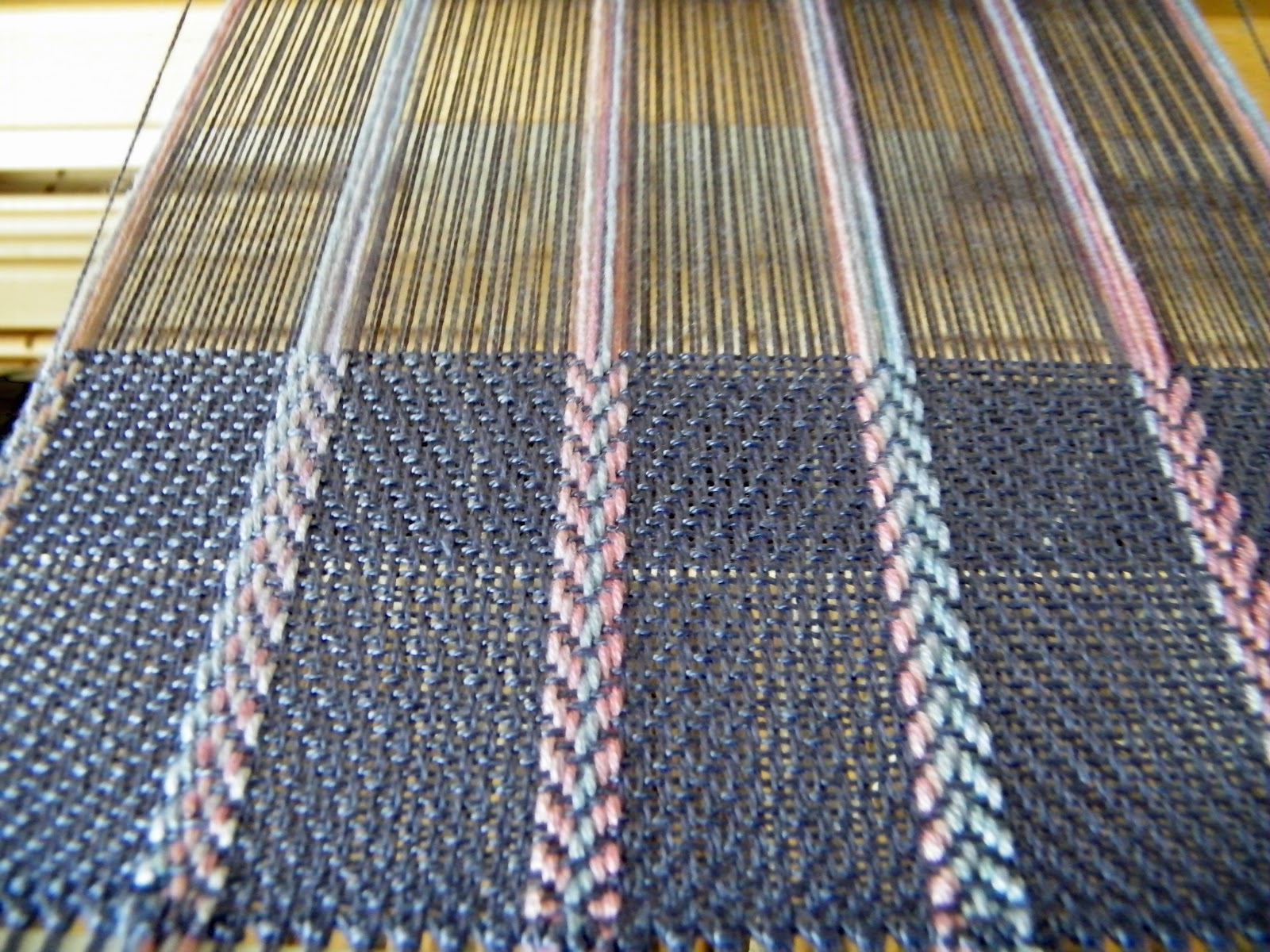
I have been wanting to explore Deflected Doubleweave for some time, so the article in Handwoven January/February 2007 by Madelyn Van Der Hoogt on page 68 caught my eye as it is really graphic.

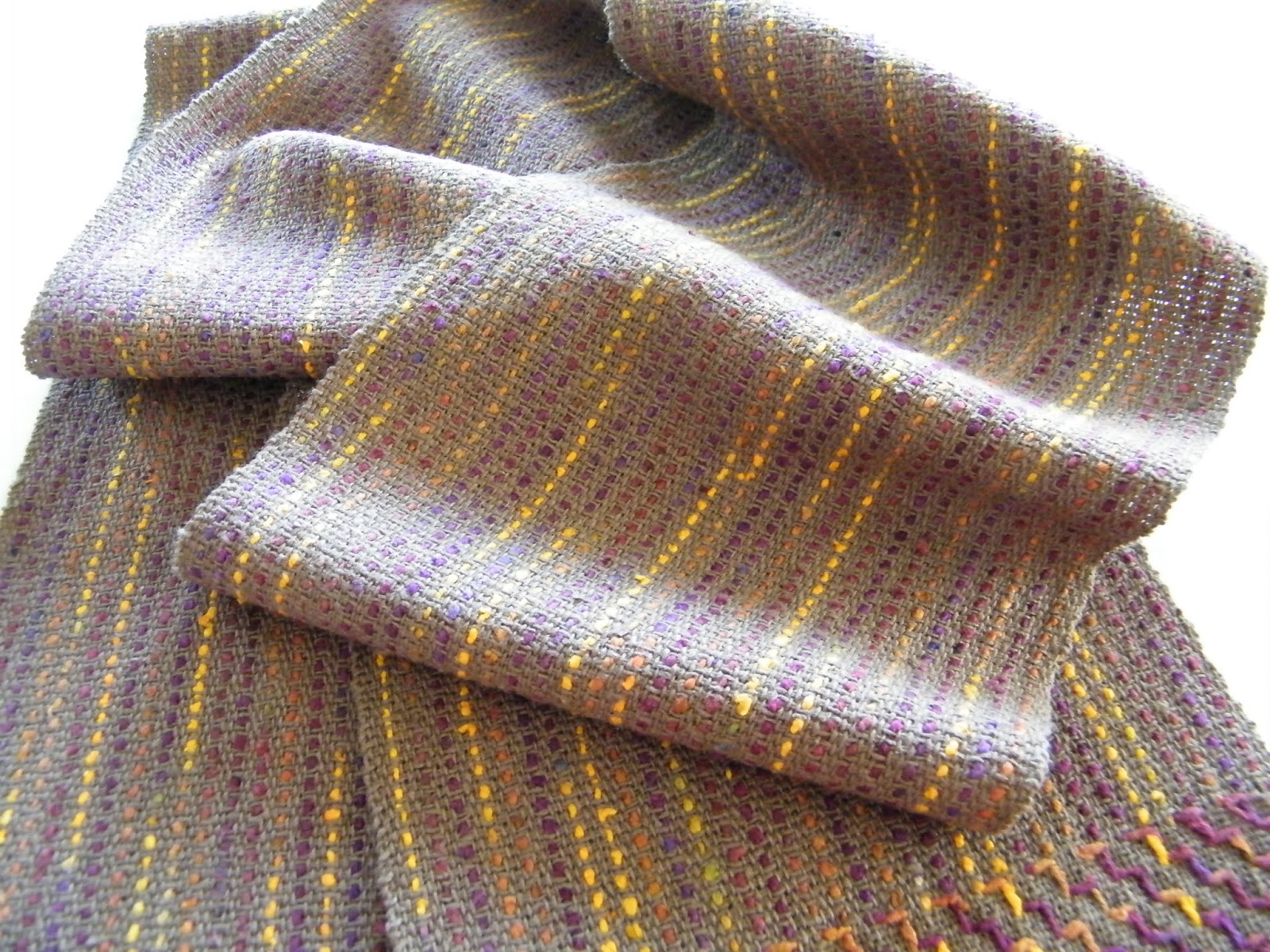
I plan to weave two scarves using two colours of silk, natural coloured 30/1 tussah silk and the other is soft chocolate 30/1 bombyx silk.  Due to the fine grist of the yarns I chose to weave at 40 epi in a 20 dent reed with 2 ends per dent, rather than what was suggested in the magazine article.

I have used both of these silks before with really lovely results.
The natural silk was woven in squares and I used leno to ensure that the square stayed in place.  I was lucky enough to have this scarf published in Handwoven May/June 2011.
This is the chocolate silk woven with heavy raw silk streaks in the warp.
I pulled the warp in two sections and the first section sat on the warping board overnight.  The next day I made the second section and immediately started warping the loom.
As I started pulling the warp, which is 4 ends of chocolate and 4 ends of natural; a snarling, bridging grabbing problem started to rear its ugly head.  I was completely taken aback because alone, neither of these yarns caused any problems when I used them previously.

The section that had just come off the warping board was horrendous!  The section that sat on the warping board overnight was much better behaved, so time to relax may have been the difference.
The warp was pulled on by inches and the whole six yards took over an excruciating hour to get onto the loom.

These yarns did not get better after they were on the loom, just sitting on the lease sticks the warp ends bridged together.
And each individual thread had to be teased out of a curling mess!  Not fun at all.
I’m halfway through pulling the warp through the reed and now I’m questioning whether I should have gone for such a fine reed, but only time will tell.  It was a conundrum, if I put 4 ends together in a 10 dent reed, the warp would have more twisting opportunities but 2 ends in a 20 dent reed mean they can stick more.

I rarely follow a weaving ‘recipe’ but this time I am while I learn the in’s and out’s of Deflected Doubleweave.  I have put on enough warp for two scarves and the second scarf will have an original treadling sequence so I can make two different scarves.  At this point its ‘fingers crossed’!
My sweater is progressing at a snail’s pace right now, each circular row takes me 30 minutes to knit and this navy is really hard to knit at night, so I'm just doing a couple of rows a day.

Thursday, June 2, 2016

Inspiration from Piano Scarves

Have you got your copy of Handwoven May/June 2016 yet?  In it Peg Cherre from Weaving a Gem of a Life has an article.  She made a spectacular Cityscape scarf with inspiration from my weft clasped chenille piano scarves from all the way back in 2011!  It is super cool that the blog has inspired someone; I know that I get inspired from other blogs.

Here I would show a picture of the Handwoven Magazine but I haven’t received my copy yet!

So I might as well do an update on the latest batch of piano scarves.  I had a problem with the dryer it made some holes in the hem area of one of the piano scarves.  So I had to remove my preferred pointy end and just do a squared off hem.  But they still look great.  You can see an example of pointy end hem on the diversified plain weave polka dot scarf.
I still need to finish hemming one scarf and taking new pictures for Etsy but they will be up for sale soon.


Monday, March 14, 2016

Theo Moorman on Three Shafts ~ A Scarf

I am involved in a study group with my guild, the Qualicum Weavers and Spinners; and this year our topic is inlay.

I thought I’d take a look at the Theo Moorman technique of inlay and see how far I can go with it. Typically, this technique is used in tapestry or ecclesiastical weaving, and it involves a surface design element laid over a woven background cloth.  The inlay is held in place by a nearly invisible tie down thread which is hidden within the warp and only surfaces when needed.

I thought I’d start with the simplest permutation of Theo Moorman; that is plain weave ground cloth and one tie down thread; so, only three shafts are needed.

I found this pattern in Handwoven Magazine May/June 2013; the pattern was created by Line Dufour (you can read her blog here).

I pulled the ground cloth warp ends separately from the tie down ends and this created a bit of a problem for me. How was I going to get them to interleave; since I prefer to warp back to front.  I ended up using two sets of lease sticks, one for each warp and after the ends were spread I lashed them together.
This worked perfectly! The ground cloth is woven on shafts 1 and 2 alternately and the surface design is laid in on shaft 3.   The tie down threads are always in play and move with shaft 1 while creating the background and independently on shaft 3.
This scarf wove up very quickly and frankly I  found it a bit boring.
 I am a bit concerned that the underside of the scarf has quite a bit of pattern telegraphing ~ not enough to be interesting but enough to notice.
I was really concerned when I pulled this scarf off the loom; it was as stiff as a board and during the weaving process the Tencel had completely lost its lustre!

I had my fingers crossed as it went into the Eucalan wash, hoping it would soften.  After it dried it was much softer but still not very supple.  I guess that it is the nature of plain weave to be firm, but this was unpleasantly firm!
I decided to throw it into the dryer with a clean towel on the Air/Fluff setting and viola ~ it came out wonderfully supple!
I will periodically be working on Theo Moorman’s technique throughout the year and I hope to see just how far I can push the concept and still make a wearable scarf or shawl.

Sunday, January 26, 2014

12 Shaft Fancy Twill - Four Scarves

This is the first warp after Lily Louet's new year tune up,  a 2/10 black tencel warp.  I purchased this  yarn from Yarns Plus before they (alas!) closed their doors.  Since the cone was getting low, I had a look online for replacement yarn and couldn’t find anyone who carries 2/10 black tencel!  Do any of you know of a supplier that you will share with me?

The warp I put on the loom is 9.5 yards long for four scarves, each scarf has been allocated 83 inches which will be 68 loom woven inches and 7 inch fringe allowances.  The first scarf has a 10 inch fringe to allow tie on to the front beam and the last scarf has a final fringe of 16 inches to allow for loom waste included.

The pattern I’m weaving is 12 shaft fancy twill that I developed based on a combination two patterns.  The first pattern was shared by my friend Susan and she showed it on this post.  The second inspirational pattern was found in Handwoven’s Design Collection #19 called ‘Peacock Shawl’. 

I’m weaving the scarves so that I can take them with me on my New Zealand trip in five weeks, not too sure if that’s enough time as I’m in a particularly poky period of late!  We have been invited to stay with several friends that my husband went to Ardmore Teachers College with in the 1970’s (yes, he’s a man who holds on to his friends!)  I thought a hand woven scarf would be a lovely hostess gift for the ladies in their lives.
The first scarf is woven using 2/10 burgundy tencel and I’m really very pleased with the pattern.
I’ve already finished the first scarf and I’ve started the second scarf in 2/10 soy silk in a lovely hand dyed bronze. 

As you probably know I live on Vancouver Island and frankly a moist environment is an understatement.  Today it’s dense fog and 100% humidity!  Needless to say wearing wool in the winter is a must for me, but I hate the tendency for wool to pill and make you look unkept.
I bought this great gadget by Conair called a Fabric Shaver and I can’t say enough great things about it!  There is a guard that allows you to choose how close you come to the fabric ~ security blanket for me!
Here is my brown wool cardigan sleeve before I attacked it, yup....gnarly barely covers it!
Here it is with one sleeve done, much, much better!

This is just the first part of the pile of pills I removed ~ amazing ~ I'm all back to smooth and warm.

Thursday, March 7, 2013

Sugarcane Fiber

It seems that lately every project that I put on the loom has a weird story…and my newest project is no exception. I’m still on my stash busting frenzy and I’m determined to make use of everything!
I bought two skeins of this amazing Sugarcane fiber yarn made in Chile while I was visiting my friend Susan in Duncan B.C. This yarn is made up of 6 strands of 2 ply sugarcane fiber that has been hand dyed and it is uber soft.
The beautiful tonal blue, pink and lilac just reached out to me and I thought I’d make a scarf with it. I had just had my Leno scarves published in Handwoven magazine May/June 2011 and I though this yarn would look great woven with the same Leno technique.
I started weaving and it was immediately apparent that the thickness and springiness of the yarn made the Leno technique on the edges of each square impossible. So, I cut if off the loom…this left me with 20 ends 6 yards long and 40 ends 3 yards long and my weft on a stick shuttle. I had no idea how I was going to use it, but someday…..
Well today is the day and I’ve just warped the loom for a spring scarf.

I pulled groups of 28 ends of 2/8 tencel in lilac in individual bouts and slipped each one over the back rod. Each block was bracketed with 7 ends of the sugarcane. The 20 ends of the sugarcane that were 6 yards long could be folded over the back rods, but the ends that were only 3 yards long had to be individually tied on….what a pain. But I think it was worth it!
I’ve just woven a few inches and I am really thrilled with the way the sugarcane adds both texture and amazing colour to the scarf. The tencel stripes are in alternating twill and the 7 ends of sugarcane fiber are in point twill. A very simple pattern but stunning don’t you think?

Friday, October 26, 2012

Finishing Up

All three Snowflake Twill table runners are off the loom and the two longer ones are in need of a hem. I will be hemming them before I wash them as I’ve found that this is the best way to line everything up perfectly.

What's the difference between a table linen and any other length of textile? The answer in my mind is the border. When I plan a table runner or table square project I plan for a selvedge border that will compliment the centre motif and a hem that will mirror the selvedge border;  however I thread the selvedge is how I treadle the hem.  Which ever weave structure you use for your runner the border should also be woven in the same structure so that the take up is the same.  When you weave twill for example and then do a plain weave hem, the hem will be much wider than the twill fabric because the threads intersect more frequently in plain weave.
For this project I planned a selvedge border of 1 ½ inches in straight twill.  You can see 3 complete runs in the photo above; so to balance the selvedges I want a visible hem of 1 ½ inches.
First I machine zigzagged the edges before cutting the woven textile apart. I only do one run of stitching as I’ve found if you go over it a number of times it creates a noticeable lump in the hem, in this case ~ less is more.
On the two table runners that I was planning to hem I wove 4 ½ inches of straight run twill at each end.
I weave 3 times the length of the hem so that it can be turned over twice evenly. If it’s not evenly folded, a line will telegraph through the hem and leave a weird mark when you press the hem.
This is the right side of the runner and you can see that the selvedge and the hem are essentially the same width and there is a square of straight twill at the corner.
Here's runner # 1 ~It’s quite funny that this pattern is in the November/December 2012 issue of Handwoven on page 27 ~ I’m going with ‘great minds think alike’!  Just imagine how nice it will look after it's washed.
This is runner #2 and is treadled with Ngaires pattern. Both of the runners pressed and pinned and ready to hemstitch and the third was too short to hemstitch, so it’s got a twisted fringe. 
This is runner #3....I used a completely different weft and the Sesame Street tune of 'one of these things is not like the others' keeps running through my head!  The weft is a cotton and linen blend that has some lumps and bumps so there is a lot of texture and slight fuzzyness.  It's the same, but completely different!

Monday, June 18, 2012

Warp Rep or Ripsmatta

I am still on a stash busting mission and Rep Weave uses a lot of yarn, so it seemed like a natural choice for me. I haven’t woven Rep Weave since 2004, when I was doing the Guild of Canadian Weavers Master Program, so I thought I’d have another look at the whole weave structure.  I found that Lila Lundells book Rep Weave to be really good.

Rep Weave gets its name from its strong horizontal ribbing; rep and rib have the same root word in French.

“Rep Weave is a derivate of Tabby with warp set so closely that it covers the weft. Two wefts are used alternately; one very heavy and another very fine. The fabric has ridges parallel to the weft. If the warp has all uneven numbered ends of one kind of yarn; and all even ends of other the fabric will have two sides woven in two different yarns. The same applies to the warp made of two alternating colours; the fabric will have one colour on one side and the second colour on the other”. Excerpt from Encyclopedia of Hand-Weaving by Stanislaw A Zielinski published by Funk & Wagnalls New York.

I decided to use two different colours of the same yarn rather than two different yarns, although that sounds pretty exciting and I may try it in the future. I found exactly the pattern that I was looking for in Handwoven Magazine September/October 1988. The article is entitled Warp Rep by Lynne Giles. The actual design is called ‘Lace’ and was designed by Catharina Carlstedt and published by Glimakra.

This is the draft that I got from the magazine and it took me forever to key it into PCW!

Ngaire had a look and noticed that I didn’t have enough heddles on 8 shafts for the pattern, so she took it to PCW and stretched it over 12 shafts for me. I still ended up making 20 extra heddles…..painfully slow! I can see an order for a few hundred more heddles will be in my future.
Pulling the 808 threads seemed to take forever, but thankfully it pulled onto the loom really easily. I’ve sett the Rep Weave at 40 ends per inch ~ 4 per dent in a 10 dent reed, so that part went quickly.

I found that the origianl draft in the magazine was just too big for my purposes, so I reduced the pattern overall to make a runner the width 20 inches. I’ve chosen to use 2/8 Orlec for the warp in mid-green and light green alternately for the warp.

Threading was pretty straightforward, but I had to really keep my mind on the colour sequence as it changes on a frequent basis and there are plenty of times where two light or two dark colours lie next to each other.  The pattern looks like it has some texture but that is an optical illusion caused when the warp colours change.
I’ve used the same 2/8 Orlec for the fine weft and thought I’d use a DK weight Acrylic Knitting Yarn for my heavy weft. It was cheap and cheerful and I thought it would wash very well.
Well that didn’t work out well at all– can you see the fluffy knitting yarn popping out between the warp threads? It's just too fluffy and poofy and it makes the pattern appear a bit fuzzy.
I went to my local yarn shop and found a skein of Butterfly Mercerized Cotton from Greece! This is a 6 ply cable yarn and it works much, much better. The cotton is very firm and it behaves itself and allows the warp to cover it completely.
This is my runner so far.
This is the runner from underneath. I took this photo lying on the floor looking up and it was much more difficult than I thought it would be!  This runner will be completely reversable.
I'd forgotten how much fun Rep Weave is ~ I'm really enjoying this simple, graphic pattern and I can't wait to see the finished result!

Tuesday, March 27, 2012

Another Really Good Day

Even though I just blogged yesterday I'm so excited I've got share!  The March/April issue of Handwoven Magazine is out and I have a project featured on pages 46-47 and 48!  I can't believe I got three whole pages!
Interweave returned my scarves along with a copy of the newest issue of Handwoven by FedEx this afternoon and now I can do a wee bit of tooting my own horn!
If you don't get the magazine you can see my Paper Spot Scarves on Weaving Today (link below) and by scrolling down until you see the photo of the scarves which have been so beautifully photographed draped over a chair...
http://www.weavingtoday.com/blogs/handwoven-issues/archive/2012/03/22/Handwoven-March-April-2012.aspx
It was so hard not share the project while I was weaving it last summer, but the reward of having it published in the 'benchmark magazine' is truly uplifting for me and it really makes me want to sit at the loom and try out new weave structures.
I've just noticed that the first project of mine that Handwoven published last year had the same page numbers!  I guess I'm a middle of magazine kinda gal! 

Friday, May 27, 2011

A Really Good Day

Yesterday was one of the best days! I received an email from a lady in Montana saying that she had just received her May/June Issue of Handwoven magazine and she saw me in it. Now that the issue is in circulation I can at last stop being a ‘secret squirrel’ about it – it was very, very hard not to say anything all these months! Later the same day I received the parcel from Handwoven returning the scarves along with a cheque and a lovely note from Madelyn Van Der Hoogt the editor; this day just keeps getting better! If you get Handwoven Magazine – yup that’s me on pages 46 and 47….and my article is titled ‘Spaced Warp with Leno’.

I wove these scarves last fall and submitted the idea to Handwoven and was thrilled when it was accepted. I wove two scarves for this article one in silk and one in bamboo. My idea was that you use a leno twist to hold the spaces in the warp and to prevent the warp threads from wandering– it sounds much more complicated than it is.

I wanted my first (and I hope not my only) submission to really look nice, so beading the fringe was essential. I’m really very happy with the way they turned out. Handwoven chose to feature the natural silk scarf, but personally the lilac bamboo was my favourite, its' the colour that really gets me and the beading was a little more flash.

Then, as the final cherry on top Michael and I went out and bought our tickets for our September holiday. We will be spending three weeks in France and I can’t believe how much I’m looking forward to the adventure. I feel that I’ve spent the last week online getting our accommodation and car organized, but it seems that the best airfare was eluding me, so off to the travel agent we went.We have booked an apartment in Paris for a week in the Montmartre a minute from the Moulon Rouge. I'm jumping the gun on this one a bit because I haven't confirmed the booking, but I'm pretty confident as the owner has agreed. Today the Paris apartment was confirmed - now I'm really getting excited!This is our gîte (a self-catering holiday home) in The Dordogne region, this one is confirmed and paid. It is in a tiny medeval village and we have it for a week.Then a few hours south east and we have our gîte in The Languedoc region for another week. This time we chose to be in the centre of a small town and right next door to the village church, it's going to be great! Then one night in a Paris hotel near the airport, then home on October 2. I can foresee some excellent wine and cheese in my future!

Now for the big question – are there any special weaving sights I should be sure to take in? If you have been to any of these regions and know of hidden fibre related gems, please, please let me know about them. We will have a car for the last two weeks and so we will be able to mosey along at our own speed and hopefully get a lovely feel for these regions of France.

Our weather continues to be unpleasant to say the least, we are having the coldest spring in fifty years according to the news and today there was 20 centimeters of wet snow dumped on the surrounding high hills. Fingers crossed for some warm weather!