Showing posts with label Dyeing. Show all posts

Monday, September 11, 2023

Finishing up the Dye Days

After the creative part of dyeing the silk warps is done, the warps sit wrapped up in plastic wrap for 24 hours.  Then the rinsing begins, just plain water to start moving out the excess dye, then a couple of drops of Synthrapol soap is added to the final rinse to remove every last speck of loose dye.

The silk warp comes out of the rinsing process in a bit of a tangled ball.  Luckily, it is really easy to fix, just grab the ends and a couple of flicks the warp is laying flat and smooth, ready to hang and dry.
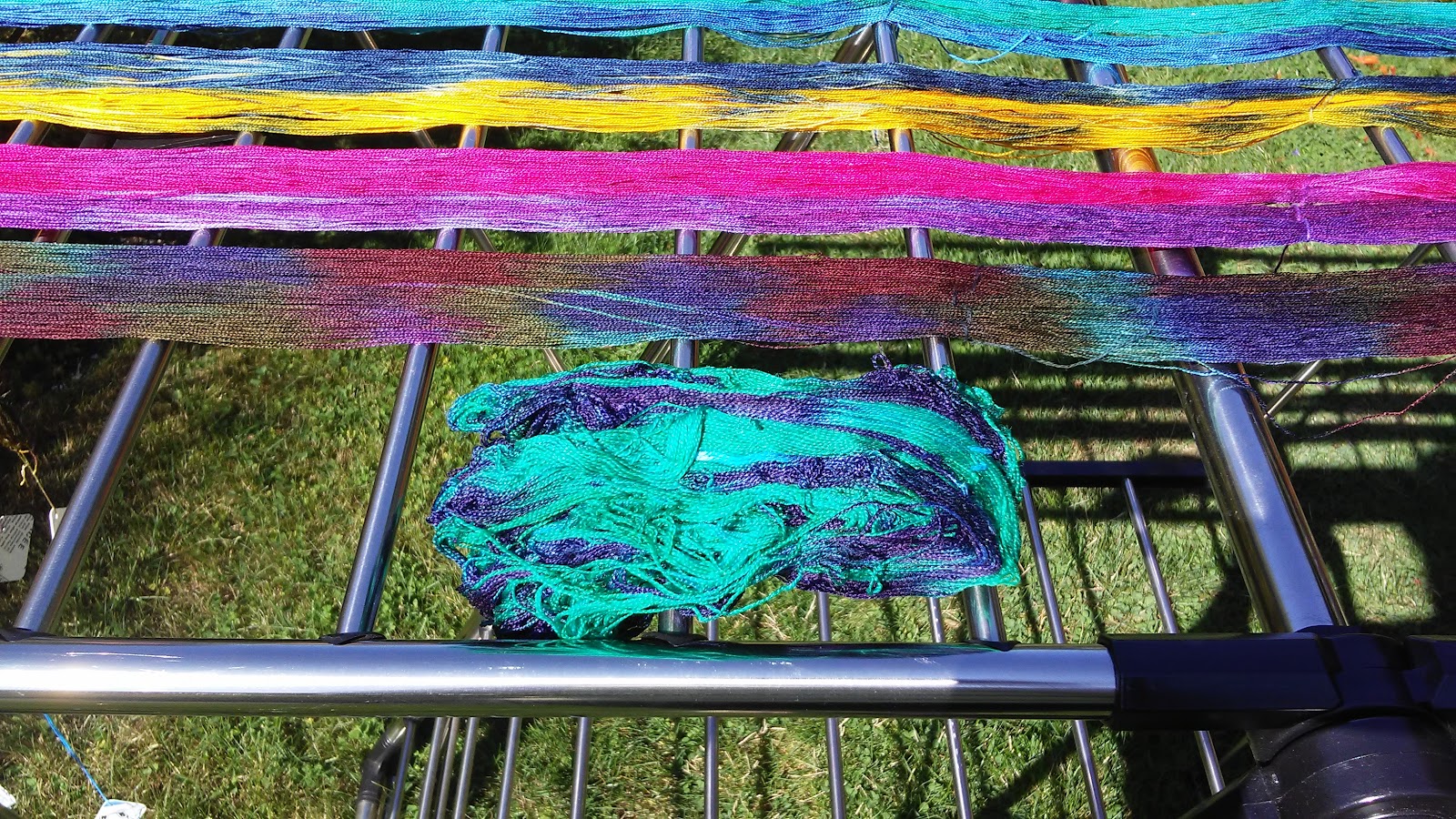
The first lot of 8 silk warps are with the 2/22 silk.  There is a couple of different painting styles on show here.  There is a long curve of colour, half and half colour and random colour splashes, anything and everything goes when dyeing like this.   There is a lot of colour here!

Since we had the dyes out I also over dyed a scarf, it was white cotton and lime green silk.  I over dyed it with navy blue Procion MX dye.  It was a multi step process but easy, just a lot of stirring.  The dye bath method took about two hours and then straight to rinsing.

This is the second lot of 8 silk warps.  There is a mix of tussah silk and a camel/silk blend.  The camel/silk blend is wonderfully soft and I’m quite excited to work with it.

I didn’t get a photo of the third lot of silk warps, I guess I’m still a little rusty in the blog making!  But here is a final photo of all the warps together.  What a wonderful range of colours!

I’m a little disappointed on how the over dyed silk scarf went.  I think that the container that I used was a little small, the instructions said to use a container that allowed the material to float freely and I thought that I had.  But the scarf has marks of where the material bent and it is lighter on one side.  So I guess that it is mine now!

Final garden photo is a Hydrangea paniculata 'Vanille Fraise' the shrub is over 8 feet tall and the heads are at least 1 foot in length.  The flowers start as white in the summer then as the nights get cooler they start to pinken.   We had a heavy rain a few weeks ago, so they are being supported a bit now. It is a spectacular highlight to the start of the autumn in the garden.

Monday, September 4, 2023

Getting Ready for a Dye Day

The weather is here on Vancouver Island is turning a corner and fall is starting to creep in.  The lovely days of planting, weeding and harvesting from the garden will be soon over and now our thoughts are turning to weaving.  

There is nothing more exciting than putting a gorgeous colourful painted warp on the loom in the cold, grey months of winter. Mom and I decided it was time to paint some warps.  It has been a few years since we last had a dye day for silk warps so I’m going to share how we do it.

We purchased some 2/22 Bombyx silk from India and we like the sett to be 24 epi (ends per inch), so for a scarf 8 inches wide we need 200 ends.  We have found that 100 inches is the perfect length for a scarf on our Louet Spring Looms; it gives 10 inches for fringe at both ends, 70 inches for woven length and some extra for take up and loom waste.  

We also pulled  warps with a few different silks; 2/30 Tussah silk, 2/30 Tsumuga silk, 1/20 Bourette silk and 2/30 Camel/Silk blend.  They all have different setts and numbers of ends so we have everything on a spreadsheet.  We also use large tags made from ice cream bucket lids with numbers on them to keep track of the warps.  We ended up pulling 24 warps!  

We set up to dye in the garage with saw horses and a long piece of plywood that was topped with a piece of rigid insulation to get to just over 100 inches in lenght, it is best to lay the warps long and straight, it really makes painting the design much easier.  It is totally jury rigged but it works and we can each paint a warp at the same time, one on each side!

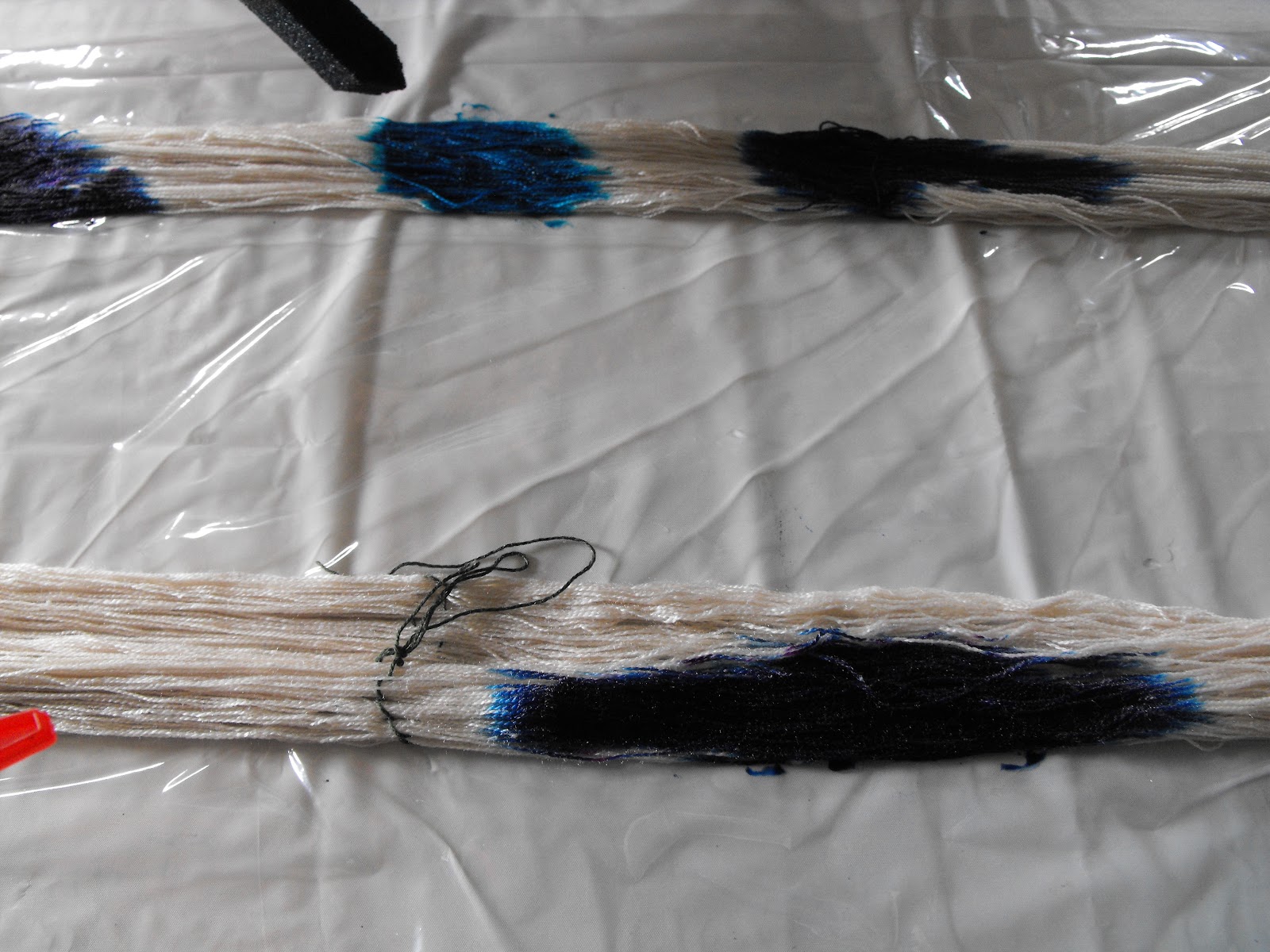
We separated the silk warps into 3 sections of 8 warps, because 24 is too many to do in one day.  So two people with 4 warps each means the dyeing only took about 2 hours to do but it still took three days.  We use Procion MX dye and the first step is to place the warps into a soda ash bath for at least 30 minutes.

The dyes get a mix of salt and urea with some dry powdered dye and then some water.  You can mix the dry powders up to get different colours like teal and magenta.  Always follow the manufacturers instructions for safety and use when using dyes.

A long piece of plastic wrap is placed on the board then the warp is squeezed dry (wear gloves!) but not rinsed and is added on top of the plastic wrap.  Carefully untwist the warp, try to get it flat but this is not an exact thing.  We use sponge brush to add the dyes to the warp.  Sometimes we do splashes and dashes of colours.  The next warp could have a long twisting curves of colours.  There is no right way to do it, every warp is different.  

Once the warp is coloured, wrap it up in the plastic wrap and leave for 24 hours.  We then put them into a plastic zippered bag just in case they leak.  Next post we rinse!

Final garden photo is of Dahlias, the bumble bees just love them.  Some are named varieties and others we grew from seeds but all are just covered in bumble bees.  The bumble bees also sleep on them over night.

Monday, April 6, 2020

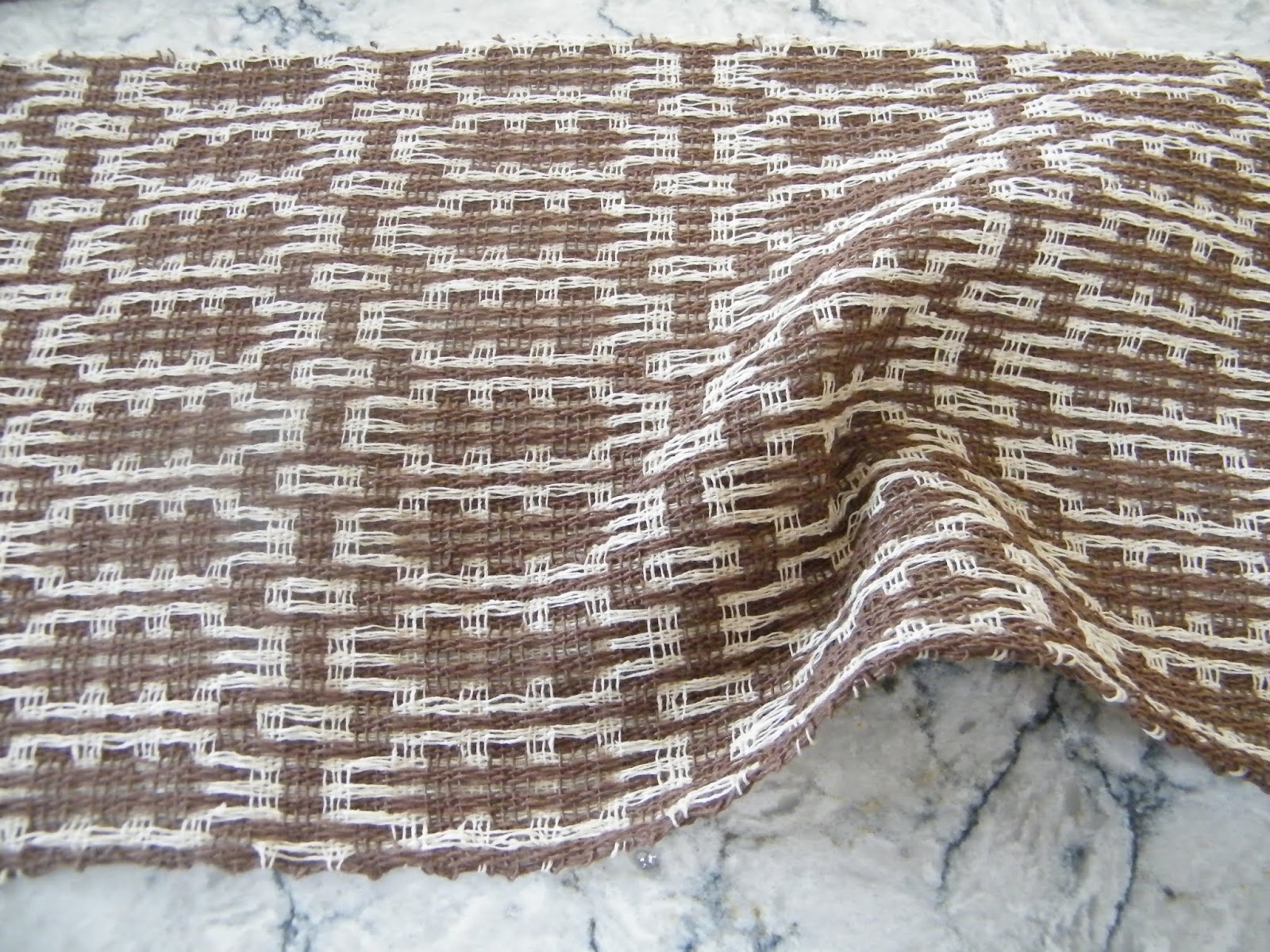
Deflected Doubleweave Rosepath Scarf

I must admit that I found it hard to sit at the loom and weave this scarf, not because of the weave structure, but because of the colour.  I just don’t care for the colour of natural raw silk ~ a bit too bone coloured for me.

I was not really pleased with the selvedges on my first scarf, so I was ready to try anything other than re-threading.  With 40 epi that was a not going to happen.
I decided to try the simplest of my options and I cut out the brown thread block on the left hand side.This left the pattern not quite centred, but it was not really noticeable.
After cutting the warp out, I replaced the brown floating selvedge with a doubled up natural thread.  I used it doubled because it is just a tad finer and more prone to breakage.
The cut out warp was bundled up into a weighted film canister and hung off the back beam.
I had hoped to replace the natural coloured weft with another colour in this scarf and I chose a lovely soft dark peach soy silk yarn that is about 2/30.  As you can see it completely muddies the pattern.
I accepted that I had to use the natural coloured silk for weft and with the new selvedges it worked really well.  On the first scarf I started both of my shuttles on the same side, but on this scarf I started my brown weft on the right hand side and my natural weft on the left.  This matched the hanging selvedges.  When I threw the weft I started out going over the hanging selvedge and coming out under the the opposite hanging selvedge.  The edges were much better.
On the first scarf I wove, I used a very firm double beat, I beat once on the open shed and once on the closed shed to get as close to a balanced weave as possible.  This made the scarf motif quite round.
On this scarf I chose to throw the idea of a balanced weave out the window and to beat it only once on the open shed.  The idea was to make a very drapey and open fabric.  I also chose to treadle the pattern in a more elongated form by repeating one of the sequences an extra set.
Here it is off the loom in it’s natural form and boy is it ever loose!
It was at this point that I decided to just get rid of the natural colour.  I soaked the scarf in soda ash and I was amazed at what came out.....yuk.....that is extra dye and sericin.  This is last rinse out of five!
I then made a light dye bath with turquoise Procion MX, salt and urea and popped the wet scarf into it overnight.
Whew, much better.  I got some lovely soft colour and the web of the fabric has come together nicely.  This scarf is very malleable and soft.
 I’m even pleased with the edges!
I am rarely one to stray off the weaving topic, but the past few days have shaken the world view of so many of us in Canada.  We feel very lucky to live on Vancouver Island, where our local pulp and paper mill is doubling production of medical grade paper for all customers.

Monday, August 26, 2019

The Last Hand Dyed Warp ~ 12 Shafts and 12 Treadles

The last  hand dyed warp I have is this 2/30 cotton.  I decided to try making a warp with fine white cotton to see how the cotton would take up dye. It started out as a mystery cone that I got at a guild sale. I had done a burn test on to see what the fiber was and it came up as cotton, but I wasn’t exactly sure what would happen when dyeing it.  The good news is the warp took up the dye beautifully and went from white to wine.
I had almost finished threading when I noticed that I had a lot of extra heddles left, turns out that I thought I had 400 threads but I only had 300.  I decided to rethread backwards so I could move the extra heddles back to the other side.  When I had finished rethreading I looked at my pattern and had the realization that I could have just dropped five threads off to balance the pattern without rethreading.  Oops!
As for weft, I only had a couple of choices that were the correct grist; if I am ever going to use this 2/30 cotton again I’m going to have to dye some of the yarn to use as weft.  The auditioned wefts, starting from the bottom are, a white cotton with shiny silver acrylic, a rose cotton, a pink cotton and the same cotton as the warp but undyed white.  The pink is the definite winner.
The 12 Shaft Advancing Twill draft has large diamonds and has quite a large repeat of 95 threads.  It is amazingly pretty and gives spots of weft, spots of warp and a definite diagonal.
The dye job for the warp wasn't perfect  and there are areas that are almost black and areas where the original white shows through but I think that it adds interest.  The ‘bad’ dye job is because I just drizzled the dye over the warp and worked it into the threads with my hands, I’m sure if I had immersion dyed the warp it would have covered the threads completely without any streaks.
How about this for luck?!  That is all the weft that I had left after I was done weaving the scarf.
As I was twizzling on the dining room table I looked up and saw that one of the Dalias in the flower arrangement matched my scarf! Ain't nature wonderful.
Here is the finished scarf.  It is really very pretty and I have the perfect jacket to go with it so it is going to be mine, mine, mine!

Final Garden Shot is a mass planting of Rudbeckia fulgida var. sullivantii 'Goldsturm' (Black-Eyed Susan).  The plants line part of our front garden border and today they were at their best.

Monday, August 19, 2019

Eight Shaft Plaited Twill Scarf

I rarely ~ make that never ~ set out to weave something for myself.  Like most weavers I get to keep the mistakes, so needless to say I have plenty of scarves!
When I saw this warp though, I knew it was for me.  The warp is raw silk that I dyed in gold and green and the notes I have for it show that it is a warp long enough for two scarves.   I wanted to weave a wider or ‘blanket’ scarf for my upcoming trip to Spain and this was the perfect time to do it.
I decided to fold the warp in half and mount it on the loom.  One end of the warp was as usual with the cross intact, and the other end had my warp counting twining in groups of 10.
I had to figure out a way of picking up a cross for the lease sticks that was quick and effective and I decided to use a netting needle to weave through the counting stitches.
It looks pretty rough, but it worked very well.
Now it was time to audition the weft.  My goal with this scarf was to wear it with a denim jacket, and ideally I would weave it with bombyx silk weft, but I just didn’t have a colour that would work.

So with that in mind I went for the next best thing and tried a bunch of 2/8 Tencel colours starting with Vert Fonce (Brassard), Grey Blue (Webs), Coquille (Brassard), Mineral Green (Webs),  and Straw (Webs).  None of them really floated my boat, but the Grey Blue seemed to show the plaited twill pattern the best and would go with denim, so I went with that.
The 8 shaft, 12 treadle plaited twill pattern is subtle on the green warp and shows nicely on the gold.  I’m loving it!
Although I expected to have plenty of warp, since this was a double scarf warp, I did not.  Upon reflection I expect the raw silk took up hugely when I was washing out the dye.  I ended up weaving right to the very end and as close to the heddles as I dared to go.
Off the loom and relaxed, it came in at 68 inches long by 16 inches wide, luckily I'm a diminutive gal, OK... make that short.... and so this is plenty long enough.
Here it is, still not steam pressed or fringe twisted, but looking wonderful on my jacket and all ready to wow them in September.

Little by little Ngaire and I are making all the technical challenges featured on the Great British Bake Off and this is our very tasty attempt at a Povitica.  Pretty, pretty loaf and yummy too!
The beauty shot from our garden is Grevillea victorae (Victoria Grevillea) which is an Australian protea.  It is loaded with these confloresenses right now and they should start opening at the end of September just when the hummingbirds need the nectar.

Monday, August 12, 2019

What was I thinking?!

My last two hand dyed warps are doozies but I’m going to get them woven.  This time I'm weaving the final dyed Tencel warp; this is going to be my last Tencel warp for the rest of the year.  The warp started as Lemon Drop Yellow then I dyed it with splatters of brown, red, green and little hints of blue.  The warp isn’t something that I would usually do, I’m more of a pretty and cheerful kinda girl, and I’m not even sure why I went with brown.
It was a really challenging warp.  I wasn’t sure if I should find a pattern first or a weft colour.  I looked for a pattern but nothing looked good so I pulled out all the Tencel bins so I could look at what colours could go with this warp.  The autumnal colours seemed to be the most promising so I went with a favourite pattern; a network twill that looks a little leaf like.
For the weft I tried two shades of red brown – Spice and Pompeii, antique gold (which is a really weird colour, gold with lots of lime green in it), taupe and a hunter green.  The red browns had some promise.

The second set of weft choices were a lighter pinky brown - Adobe, yellow, orange, the darker of the red browns from last time - Pompeii and slate grey.  I think that Pompeii, the red brown is the winner but that pattern isn’t going to work.
The small splashes of colours in the warp are really breaking up the pattern so it was hard to see.  I decided to change the pattern to something that would show the warp to its best advantage.
The new pattern is a 6 shaft twill in a diamond shape.  One side is warp dominant and the other side is weft dominant.
The Pompeii weft really shows off the soft yellow in the pattern.
I think that this scarf is going to be much prettier than I thought!
Final Garden Shot is of our Persian Silk Tree, it is blooming with lovely fluffy pink clouds of blossoms!  It is also called a Mimosa tree or my favourite the Sleeping tree (Albizia julibrissin).  It is called Sleeping tree because it will close it leaves during the night, so cute!