
The stripes are all different widths but to make things easier when pulling the warp I made sure that each stripe has an even number of ends, it took more fiddling with the pattern than you think! When the garment is cut out I want to have the front panels of the vest or jacket match so the pattern has been mirrored with a delineating line of black in the centre.
 The warp is a mixture of 2/8 Orlec and 2/8 Tencel and the weft is black 2/10 Tencel. Originally the yardage was to be 36 inches but it turns out that a 36 inch reed isn’t really that long, more like 35.75 inches. Consequently I’ve had to drop a few ends off the back beam to make it work out. I did remember to keep the cross in the dropped ends and I’ll make sure to use them in my next yardage project.
There are 5 distinct stripes’, each stripe has a mixture of yarn colours. This was to give depth and interest to each stripe. The outside is a 1/1 mixture of soft green and soft blue.
 The next is pure pink.
  The wide one is dark teal on the outside blending through two shades of light teal in the centre.
  The next is purple, lavender then silver in the centre.
  The final stripe is a Fibonacci mixture of pink and rose.
I am really enjoying the weaving; the width is just at the edge of my reach. And it is amazing how fast I am going through pirns! Thankfully Mum is doing the hard work of filling them up with the electric bobbin winder.

 After my last horrible warp, I decided to put on something that would give me some positive reinforcement. Well, this 2/8 tencel shawl is just that. It was quick, fun and very rewarding to weave! Everything I was looking for!
 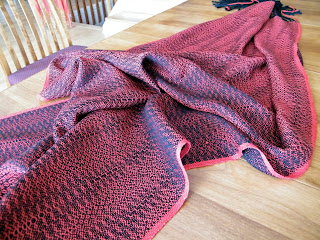 The warp is sett at 24 epi on 8 shafts and is 2/8 black tencel. The weft is the same 2/8 tencel in scarlet. I put a straight twill border of 8 ends in red on the selvedges to keep the weft turns looking good. The weave structure I used is a modified crackle, which is my structure of choice at the moment. So pretty!
 I could not believe how quickly this 80” x 24” shawl wove up. No kidding, it took no time at all even though the pattern repeat was a whopping 293 picks long. The treadling was slightly modified from the regular advancing twill so it was very quick to fall into the swing of it.
 There is a definite right light side (red) and dark side (black) to this shawl. I think of it as giving garment options to its eventual owner!
 No fancy beading yet, but that too shall come!
  I thought I’d show you what’s been keeping me away from the loom lately. Yup, that’s me up about 25 feet painting the eves…..scary doesn’t even begin to cover it!
  The change in our house is remarkable, from this…
 To this….
 I really like the first project I did on the AVL. The green Crackle scarf with the tone on tone colour way really made the Crackle pattern pop. So I decided to do another scarf in the same pattern with 2/8 Tencel using Adobe for the warp and Sea Coral as the weft.
 The above picture is quite purple but the scarf is more rosy in colour like the below picture. While I was weaving a way my loom made a horrible crunching sound and I wasn’t sure what happened. It turned out that one of the bars skipped; of course I didn’t figure it out until quite a bit later when I could see the mistake in the pattern. I haven’t quite figured out how to go backward yet, so I decided to weave a few more picks and then to fix the miss while still on the loom and under tension by needle weaving in the missing weft pick.
 I used blue thread to follow the correct thread in the next pattern repeat. It really helped to keep track of the pattern pick that I needed to copy.
 This photo is in front of the heddles.
  It was just as bad behind the heddles, except I had the added advantage of nice little pills of linen being produced to make nice snarls and uneven tension for me!
 So, without further ado and as cavalierly as possible; I cut it off!!!
 I still had the warp through my reed and well secured, so before I did anything else I put Minervas’ least sticks in the warp and tied them well to the Spring loom. Then I pulled the remaining warp off the back beam to the front of the loom so I could get to where it was attached to the Spring loom back beam. I pulled the Leclerc loom back to back with the Spring loom and inserted Minerva’s back rod next to the one on Lily Louet capturing the warp, luckily, I wind on back to front so there was a lovely loop to catch. I then pulled Lily’s rod out.
 Then crossing my fingers and toes, Ngaire and I started to wind the warp which was still through the Springs’ heddles and reed onto the Minerva’s back beam.
  Surprisingly, it went very smoothly. I stopped just before the warp got to the lease sticks.
  After untying the lease sticks we flipped them from the Spring Loom over to the Leclerc and tied them to the castle and I was ready to start threading again. I decided to take a break from Overshot at this point and here it sits!
  Since my lovely Lily Louet was bare now I decided to try something completely different! I have pulled 935 ends of 1 ply fine linen for a 20” runner…..yup that’s 48 epi!
  I used 4 different 16/1 linen yarns which I blended on the warping board. I have had these kicking around my stash for yonks and they were looking a bit sad, so I thought that now was the time.
  Oh crap…..they bridge like crazy!!!!
  I’ve now got 2/3 of the warp through the heddles and hopefully I’ll finish today and have some weaving to show for the next blog.
 I found the basic pattern on
  Weaving on the AVL is taking some getting used to because the treadling is totally unique. I have to make sure that I am sitting directly over the treadles and that my whole foot is being used to depress the treadles. If I use just the ball of my foot the pain after a few minutes is like wearing 6” spike heels for a day!
 I was worried about the hard beat I felt I was getting with Avril, and feared that it would turn out like a board. After washing the 2/8 Tencel really came into its own and it’s soft, supple and oh so shiny!
 As you probably know Overshot should be woven square with the same number of pattern and tabby wefts as the warp. I’ve sett my warp at 20 epi, so I have 20 tabby picks and 20 pattern picks in every inch. My Louet Spring loom is not happy with the hard beat I have to use to get my weft packed in.
  I created this Overshot pattern and am weaving it ‘as drawn in’ star fashion, so that there is a strong 45 degree angle from corner to corner. I used the Name Draft technique to find the pattern and kept plugging along until I got one I liked, then I made borders to compliment the pattern.
 One way to weave Overshot is ‘woven as drawn in’. This means that the treadling sequence is exactly the same as the threading sequence…well sort of. To make this happen you have to do a little fudging on the treadling. You write down the threading sequence and when you see 121 you think of this as block A and fill all three of them in on shaft 1; 232 is block B and is filled on shaft 2 etc., before you know it you have a pattern!