What makes a weft right for the project? I think it should have several characteristics: good colour, good size and foremost it should enhance the weave structure. This is my new weft and it does all of the above!

As you no doubt noticed the variegated turquoise Tencel really hid my weave structure and it took 48 picks to make 5/8", so off it came!
The Tencel warp threads and silk selvedges are fragile and can’t take a lot of unweaving so cutting out was my only option.

Choosing a spot about ¼” in from the selvedge I hook out a few weft threads and cut. I repeat this on both sides.

Using my fingers I pull away the warp threads from the selvedge, one at a time.

That just leaves a fringe of selvedges threads that basically fall into your hands.

Now I use a blunt needle and hook out several weft picks from the still woven center.

Using my fingers I pull them out.

The hard part is tossing these wee bits of yarn away, especially if they are expensive!

I’ve changed the weft to 2/8 bamboo in a lovely blue, so now the pattern shows nicely and I'm much happier about finishing the scarf. You can see the circles beginning to develop in the scarf, finally!
Now for something fun; I bought a Lucet when I was at ANWG and have made my maiden braid. It will be great for handmade frogs or Chinese Knot buttons! Have any of you tried one yet?
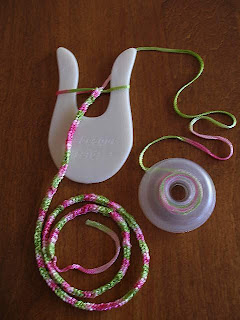
The Lucet is a tool from medieval times and it was used to make a square braid that is essentially knitted. This tool gives you a nice tight braid that was used for lacing corsets because a square braid didn’t slip undone as easily as a round braid, and we all know how important that is! It is just like spool knitting or finger weaving, fast and fun - great for kids!

The Lucet came with this neat yarn spool that reminds me of a suction cup, you open it up to wind on your yarn then fold it in on itself to hold it in place. I bought 16 more to use with my Kumihimo Plates, so now I can't use tangled yarns as an excuse not to Kumihimo!
Weaving Words
The English surname Walker actually means felter because the verb walk is derived from waulk the act of compressing wool into felt.
 Right side.
 And the reverse. As you can see I have a dark purple selvedge on both sides and rather than have a single purple twizzled lock, I decided to try something different.
 The beads I chose were #11 seed beads and #8 seed beads.
  This is the tool to make it easier.
 The needle threader will hold 3 seed beads at a time.
  Then one by one you just flick them onto the warp threads, it’s very quick and painless.
  I chose to put one #11 bead on each of the purple ends.
  After the individual seed beads I wanted a larger bead to anchor the smaller beads in place.
 Then back through the bead to pick up the rest of the fringe, it was so easy!
  I think the fringe is unique and very eye catching, without making the fringe heavy.

 The warp is a huge mess… the warp must have come partially off at some point, and it was just looped back over the beam and hanging in knotty piles at the back of the loom! We had to do some major loom changes before we got to the warping process. The loom was using two dowels hanging from a third bigger dowel to hold the shafts in place. The dowels were different weights which didn't help the balancing problem, so off they came!
 Although I still haven’t got this loom balanced correctly yet, I needed to keep moving forward so we changed the jury rigged dowels that were on the loom to the heddle horses that the manufacturer sent with the loom. Pretty aren't they?
 There are even nifty shaft holders to keep everything in place and the shafts even while you are threading, so we put them on too.
 The book has wonderful diagrams of how the heddle horses should work and it’s very easy to understand how it should work; it’s just a bunch of fiddling that needs doing to get it to work!
 I unraveled the warp back to where I could see some order, about 3 yards back, and knew I needed lease sticks.
  One by laborious one with my daughters' help we’ve pulled each thread through the lease sticks, over and under ad nauseum, then pulled through to the front where it now languishes in neat bundles.
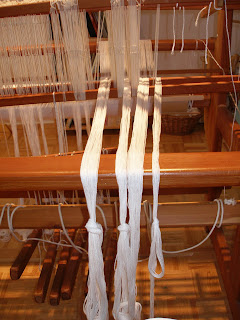 I’ve double checked the number of threads, yet again,and naturally just to make this a much longer process I have decided I don’t want to do the Landis Valley Linen pattern! I want to weave the whole warp off in one piece and then cut to the appropriate place mat size. Now back to the computer I go to figure out a pattern that doesn’t need borders. Stalled again.....Arrrgggghhh! Right now I have one of each major type of floor loom in the studio - very neat, but a bit crowded!
 This is a variation of Frost Flowers from Twill Trills and shows radial symmetry. I used 2/8 silver Tencel for the warp with just 4 purple Tencel threads on each border. The weft is hand dyed 2/20 Bombyx Silk. When I weave with warp and weft that are really different, I put a thin border on each selvedge in a colour the same as or close to the weft threads, this really minimizes the weft turns and can be a neat design detail.
 This is my draft.
 I felt a bit tired of purple weft after this third scarf and defined patterns, although fun to weave I am in need of change.
  Changing the selvedges really makes a mess at the back of the loom, but since I threaded them through plastic mesh, it’s a somewhat controlled mess. I now have 10 film cannisters and the old selvedge threads hanging at the back of the loom!
 I didn’t want to change my tie up, so went to PCW Silver and let this wonderful program make the change for me; this is the same treadling changed to network treadling.
 Then came the problems…..the weft I though would be great, tanked! I wove and cut out 4 different wefts, finally deciding on 2/20 Tencel that I had hand painted. These photos don’t do it justice, it’s lustrous and the pattern although muted does show through and because it is such fine Tencel it should have great drape.
 When I came back from ANWG my daughter had filled the house with flowers from my garden. It made me feel wonderful, so I thought I’d share them with you.
 Zen Pansies by my bedside for sweet dreams.
 A bowl of Clematis in the dining room, so pretty.
 Nine brand new Weavers Magazines! And to make it even better The Yarn Barn of Kansas was selling them at the original cover price! It was such a more than fair deal that I proceeded to spend the bulk of my money with them.
 From Glimakra I bought a wonderful 8 inch temple. It’s the smallest temple that they make and it fills out my temple collection.
 This one is called Latte and is made from dewatering skim milk and is 100% green certificated. Apparently it can be difficult to spin, but smells lovely and will be worth the trouble I think. It looks so silky and shiny.
 This bag was one of those discounted items that really caught my colour eye; 50% Wool and 50% soy silk. Yummy!
 So I just had to buy this book on Braids. I haven’t read it thoroughly yet, but there is so much information that I can’t fail to learn embellishments.
 Now a picture of the new and improved Minerva . . .
 The sectional parts from the first back beam and the second back bar were taken off, because I have been having tension problems. The problem came from when each one inch section was wound; it was wound at a different tension. So I have changed to the same style of back beam as my Mum’s Louet Spring.
 This was the loom waste, it was for the entire scarf, ok, I had a little bit more from the trimming of the fringe but it was just a little bit more. My last project, the blue Finnish lace runner, the loom waste was huge and shameful. For this alone the renovation was worth it but there is more good stuff to come!
  For my project I chose to do Bead Leno again. I went with perled mercerized cotton that was hand dyed with lime green and yellow. It was a little elastic and that made for a strange effect as I was weaving. Some of the twists relaxed and flattened out, I had no idea what the finished scarf would look like.
 Now at the end of the warp, I was amazed by the shed that I was able to get. Instead of having to finish weaving when the first knot reached the top of the back beam, I was able to weave until the back bar reached the back of the heddles. It was fantastic!
 The new weaving skill that I learned with this project was hem stitching. I really like the finish. Hopefully I will remember how to hem stitch for the next project!
 After washing the scarf the sticky fringe made lovely long corkscrews so I had to do a fringe finish that would keep the threads seperated. Four threads knotted at one inch with two green seed beads.
 The finished project was a total surprise, the scarf looks totally different from my other Bead Leno scarves. Parts of the warp collapsed and others over twisted which makes for a very interesting texture.

 I made a necklace scarf!