Showing posts with label PCW Fiberworks. Show all posts

Wednesday, August 26, 2020

Fleur de Lis Diversified Plain Weave Again

 There is so much going on around here that I completely forgot to write about the progress on my Fleur de Lis in Diversified Plain Weave this week.

It certainly has been a voyage of discovery for me beginning with the ‘aha’ moment when I discovered that my treadling was upside down!

I guess that my usual style of pattern motif is symmetrical and this Fleur de Lis is definitely not that.  I printed the treadling off of Fibreworks and got down to weaving and although I thought the motif was weird, I was so focused on the selvedges that it didn’t click right away that it was upside down.

Once the entire motif was woven, it was apparent that I had forgotten that the pattern is pictured on Fiberworks from behind the loom, not from in front of the loom.

I know that it really doesn’t matter in which direction the pattern appears since it will the same from top to bottom on the runner.  I just didn’t like weaving it upside down, it messed with my thought pattern (I really am a linear kind of gal!)  So, I unwove the pattern and re-wove it from the bottom of the pattern to the top and I’m much happier.

Usually I am meticulous about when and how I add new threads to the web, habitually I add at the selvedges.  For some reason,  I decided to add the new fine thread whilst in the midst of the runner.....why, why, a thousand times why?   You can barely notice it on this side of the cloth (about 10 threads to the left of the flower), but I got a glimpse of the other side while advancing the warp and yup, there is was, front and centre!  

As I near the end of the runner, yet another problem has appeared.  My hanging selvedge threads which were made out of the ‘not cotton’ thick warp threads have started to fuzz and fray and snap. 

I have had to re-hang the selvedges twice on the right hand side so, I will be pulling off these ‘not cotton’ selvedges and replacing them with 2/8 cotton for the next runner.

Speaking of the next runner, while I was weaving this runner I noticed that treadle #5 and treadle #14 were the same. I haven't a clue why I didn’t see it before.  Regardless, I went back to the computer and with some fiddling around I was able to amend my Fleur de Lis and make just a wee improvement now that I had another treadle to play with.

I think that the little drop near the bottom of the motif takes it out of ‘possible space ship’ motif and firmly anchors it in Fleur de Lis!

The garden shot today is of the greenhouses’ progress with our Vanilla Strawberry hydrangea (Hydrangea paniculata’Renhy’) in the foreground.


Monday, May 6, 2019

How to Draft a Motif in Diversified Plain Weave

My study group, Exploring More, is looking at drafting a motif in different weave structures, the first was Huck Lace, and the second was Summer and Winter.  The third is Diversified Plain Weave and I am going to take you through how I drafted a pattern.

I am going to use the new method for weaving Diversified Plain Weave, which is uses less shafts and has an easier treadling method.

First thing is to choose a motif; I am going to use the same angelfish from the previous two posts.
Next is the threading; looking at the angelfish motif there is vertical symmetry so again the threading will be in point order (i.e. in a V shape).  Use the threading blocks for the new Diversified Plain Weave which are Block A 123 Block B 124 Block C 125 etc.  The tabby shafts 1 and 2 are in a thinner grist than the pattern shafts.  I used an orange colour to highlight them.

The old Diversified Plain Weave threading blocks are Block A 232141 Block B 252161 etc.  There are two pattern shafts required for each block with the old style.  So by using the new Diversified Plain Weave threading blocks more pattern is created using fewer shafts.
The basic tie up for the new Diversified Plain Weave is to have the first two treadles be tabby shafts versus the pattern shafts.  The pattern shafts then all have shaft 1 added to them.

The old Diversified Plain Weave tie up had the first two treadles as plain weave as opposites.  And the pattern shafts also had plain weave on opposites along the bottom of the treadles.  This created little squares of plain weave with the thinner tabby threads and the overall fabric had a basket weave affect.
Now for the tie up, just take the graph of the angelfish and place on its side with the top of the motif facing to the left, just like for Summer and Winter.  Just use the angelfish motif to create the pattern from number 6 down to 1.
Now add the pattern shafts to the basic set up.  You will notice that the tie up is quite similar to Summer and Winter, although without the ‘pairs’ of pattern treadles.
For the treadling I look back at the angelfish graph and can see that each treadle corresponds to a single unit, there is no symmetry.  I will place the pattern treadles in straight order (in a straight line).  The treadling block for the new Diversified Plain Weave is Block A 123 Block B 124 Block C 125 etc.

The old Diversified Plain Weave treadling blocks were Block A 232 Block B 141 Block C 252 etc.  While weaving it could be very easy to lose track of which tabby you were using.
The finished angelfish is 9 Shafts and 12 Treadles.  There is a lot of playing around that you can do with Diversified Plain Weave, for example how big of a difference between the grists of the pattern and tabby threads do you want or do you want to highlight the thinner tabby lines or do you want to hide them?  Below I thickened the pattern threads in the warp and weft. 
So that’s a small guide to how to design a motif in Diversified Plain Weave.  For more information about the new versus old types of Diversified Plain Weave go to Weavers Issue 36 Summer 1997, the article is called Thick ‘n Thin Again by Madelyn van der Hoogt.

Monday, April 22, 2019

How to Draft a Motif in Summer and Winter

My study group, Exploring More, is looking at drafting a motif using different weave structures, the first weave structure was Huck Lace and here is the post.  The second weave structure we looked at was Summer and Winter and I am going to take you through how I drafted a pattern.

First thing is to choose a motif; I am going to use the same angelfish from the Huck Lace.  Please just click on the photos and it will make them larger.
Looking at the angelfish motif there is vertical symmetry so again the threading will be in point order (i.e. in a V shape).  Use the standard Summer and Winter threading blocks which are Block A 1323 Block B 1424 Block C 1525 etc.
Now for the tie up, which is quite easy, just take the graph of the angelfish and place on its side with the top of the motif facing to the left.
Summer and Winter is quite greedy for treadles.  You have probably heard of ‘in pairs’ in reference to Summer and Winter that is because there needs to be two treadles for each pattern pick.  One treadle has Shaft 1 on it (P1) and the other treadle has Shaft 2 on it (P2), but they both have the same pattern treadles.  Here is a basic set up; it just needs the pattern to be added.
I’ve added the pattern from the graph; every pattern has two treadles, a P1 and a P2.  Shaft 3 is left blank because it is the shaft that is used to separate the motifs.  I also left treadle 3 and 4 blank as they are the breaks between the motifs in the treadling.
Here is the treading and tie up together.
What makes Summer and Winter special is that there are different treadlings variations; Singles (also known as non pairs), Pairs (there is two different types; X’s and O’s), and Dukagang (also known Overshot).  To treadle my angelfish I look back at the angelfish graph and can see that each treadle corresponds to a single unit, there is no symmetry.  I will place the treadles in straight order (in a straight line) and in one of the Summer and Winter treadling variations, which I will explain with each example.

The first is Singles which is tabby 1 P1 tabby 2 P2 and gives a brick like pattern.  As is standard for Summer and Winter I’ve put the tabby in with a finer grist and in the same colour as the warp. This really keeps the shape of the angelfish.
Next variation is Pairs X’s the treadling repeat is tabby 1 P2 tabby 2 P1 tabby 1 P1 tabby 2 P2. The anglefish almost look like rockets now.
Next is Pairs O’s also known as bird’s eye.  The treadling repeat is tabby 1 P1 tabby 2 P2 tabby 1 P2 tabby 2 P1.  The tail of the angelfish are very well defined in this method.
Last variation is Dukagang.  The treadling repeat is tabby 1 P1 tabby 2 P1 tabby 1 P1 tabby 2 P1.  It uses the least amount of treadles, from 22 down to 12. This is the most columnar of them all.
So that’s how to draft a motif in Summer and Winter.  If you would like to know more about drafting I recommend The complete Book of Drafting for Handweavers by Madelyn van der Hoogt.

Monday, April 15, 2019

Going Backwards Fast...

I wove these tea towels a few months ago.
It was a really enjoyable weave and the tea towels turned out really nicely, so using the pattern as a springboard I created this pattern.
I decided to use white stripes alternating with four other colours:  mid green, dark turquoise, dusty purple, dark teal and mid green again; then mirroring the stripe sequence.
It looked really good as I pulled on the warp and so then my thoughts went to weft.  I decided to weave the pattern as big squares.  To achieve this I needed two wefts, so silver and white were my choices.
I wove about half of a tea towel and by then it was apparent.....this did not work.  I had put white edges on the tea towel 20 ends and I thought that this would stabilize the edge.
Nope, didn’t happen.  I can really see the wave effect when I change the weft and the treadling.  So lesson learned, if it works as a small motif, it will not necessarily translate into a large motif well.
I started to un-weave my work and found that I go tired of that really, really fast, so I decided to cut the weft out.  Besides being the fastest option, it is also the easiest on the web.
After I have snipped the weft threads a centimetre or so from the edges, I use a darning needle and pull the weft out from the centre.  I plan to un-thread the loom and find another pattern to weave.
I want to weave off these tea towels, so I’m going make the stripes narrower and look at doing some kind of eight shaft twill.  I hope that making the stripes narrower will make me fall in love with these towels!
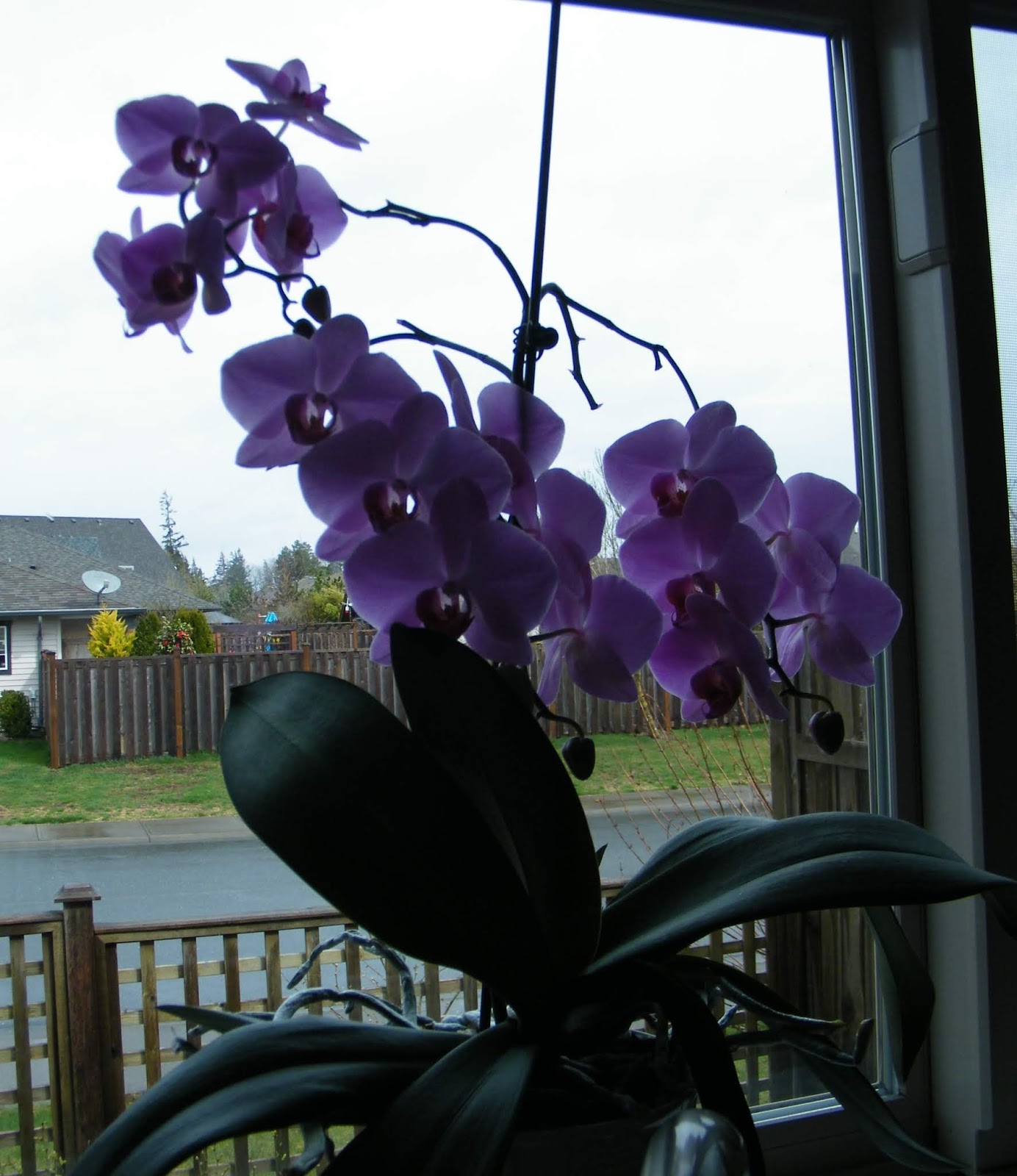
The garden is still in that ‘not quite spring’ stage, but my moth orchid put up one spike this year and it is absolutely loaded with blooms.  I has been in flower since February and shows little sign of stopping.

Monday, April 8, 2019

How to Draft a Motif in Huck Lace

For the first half of the year in my Guilds study group, Exploring More, the topic was taking a motif and drafting it in various weave structures.  The first weave structure that we did was Lace, and I am going to take you through how I drafted a pattern.

We choose to do a Lace Weave first because it has clearly defined blocks and has a relatively large number of pattern shafts.  I chose to do a Huck Lace because I like the look of the interlacements.
The first thing is to choose a motif.  I chose something that has symmetry, so I can have a larger image using less pattern shafts.  Let’s try this cute angel fish.
For Huck Lace the first two shafts are the background shafts, they don’t affect the pattern.  But the rest of the shafts are pattern shafts.  In my case I have a 12 shaft loom so minus the two background shafts I have 10 pattern shafts.  For my fish I only need six pattern shafts so I have plenty of shafts.
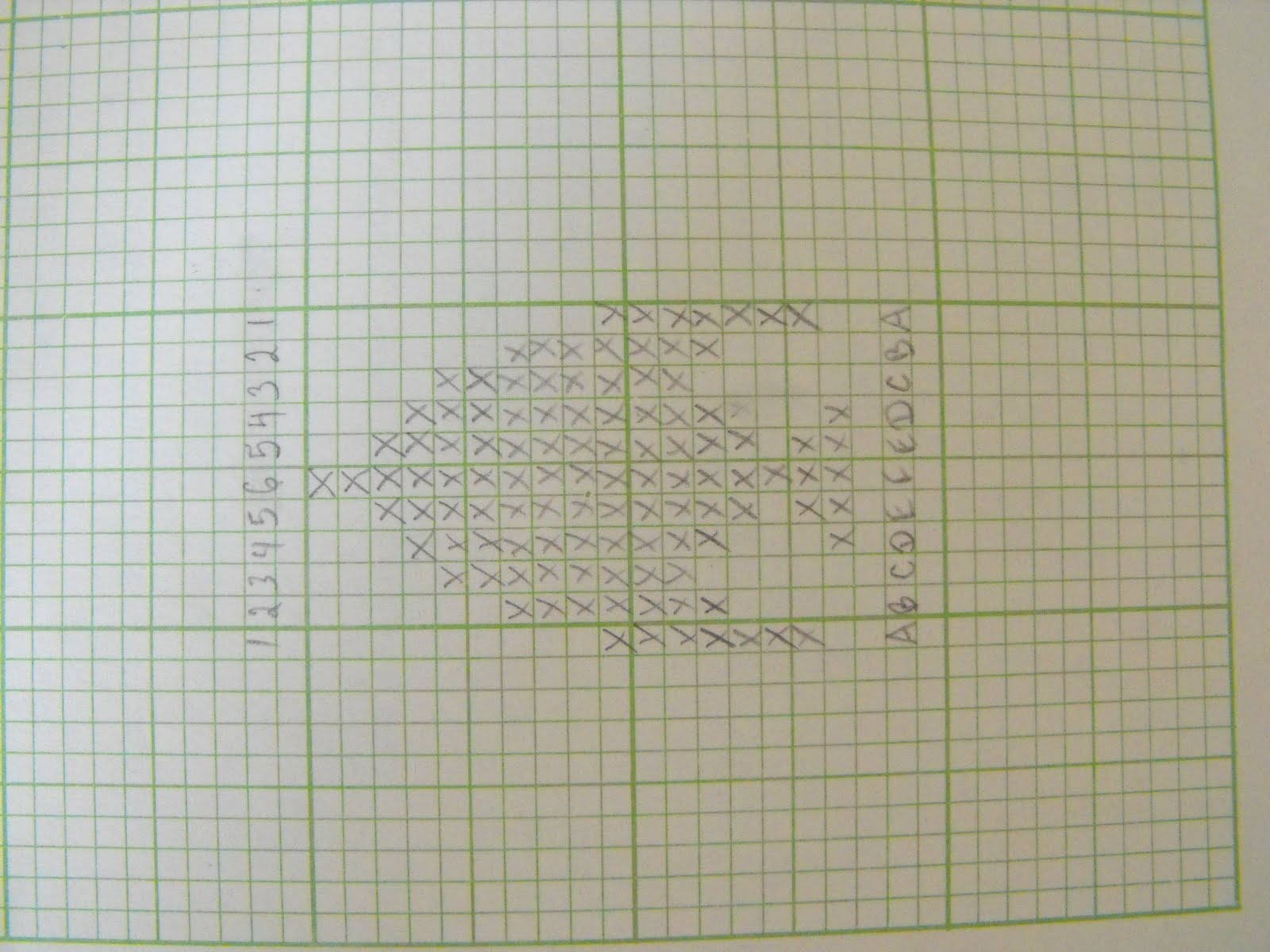
So, now is the time to get out the Huck Lace graph paper.  You have probably seen in the back of Lace weaving books or Drafting books.  This sample is from The Complete Book of Drafting for Handweavers by Madelyn van der Hoogt.  I actually find it too small to use and I only need a small portion to use for my motif.  So I make my own when I graph the image.
For a motif you are going to thread the blocks in either straight order (i.e. in a straight line) or point order (i.e. in a V shape), with the fish I will be using point order because I have horizontal symmetry and it cuts down on the number of shafts needed.  Use the standard Huck Lace threading blocks which are Block A is 23232 Block B is 14141 Block C is 25252 etc.
Now is the time to add the hash marks into the graph.  The hash marks alternate between |, which are warp floats and the –, which are weft floats.  I wanted the nose of the fish to be a warp float Huck Lace unit so I started with the | hashing there and worked back across the line.  Then I add the rest of the hash marks to the graph.  The hashing alternated between EO (even odd) and OE (odd even).
To figure out the tie up a new graph is needed.  This new graph is set up in alternating plain weave.  This is where the EO (even odd) and OE (odd even) stuff comes into play.  My first line on the fish graph is EO so I start with the odd number plain weave line.
To fill in the new graph I look across at the fish graph and look at the purple highlighted areas.  On the fish graph I have numbers 3-8 running on the top of the graph these are the shaft numbers.

If the highlighted area has a |, that shaft number is added to the new graph, which created a warp float unit.  If the highlighted area has a  –, the shaft number is subtracted from the new graph, which creates a weft float unit.
Looking at the first line the highlighted area is a | and on shaft 8 so it gets added to the new graph.  The second line the highlighted area is a – and on shaft 8 so it gets removed from the new graph.  Continue adding and subtracting until done.  This is now the tie up, instead of reading it from the bottom up, read it from the right to the left.
For the treadling I look back at the fish graph and can see that each treadle corresponds to a single unit, there is no symmetry.  I will place the treadles in straight order (in a straight line) in the Huck Lace manner, which is the same as the threading blocks, Block A is 23232, Block B is 14141 etc.  I now have all the information that I need to weave the fish, I don’t need to put it into a weaving program.  But I will so you can see the final product!
There are some duplicate treadles that I can take out, down to 15 treadles from 19.  But there is still too many treadles needed from my loom.
If I take out the alternating huck lace units I can get down to 10 treadles but I think that the fish looks funny.  If I was going to weave this fish I think that I would add back the alternating huck units and just have the nose as a duplicate and that would get me down to 14 treadles, which is what I have on my loom.  Of course this isn't a consideration if you used a table loom!
So there you go a small guide to drafting a motif in huck lace!  If you would like to know more about drafting I recommend The Complete Book of Drafting for Handweavers by Madelyn van der Hoogt.

Monday, September 7, 2015

The Evolution of a Weaving Project

How does a weaving project begin?  Today it began with a general need to weave something.  It’s a grey day and my lovely Lily Louet is naked. Tea towels have been selling well for me lately so I opened up my PCW draft folder and started poking around in my tea towel folder pattern folder looking for inspiration. Click on the photo to make it bigger.
I remembered a seeing an interesting pattern in 4 shaft twill from one of the Guild of Canadian Weavers exchanges; naturally I couldn’t find it right off so I thought I’d look through some photos of past projects to see if I could spot it.  Have I mentioned that my attention span is that of a gnat?
Still no luck so I went to the blog to search out past projects and ‘viola!’ found this great runner that Ngaire wove ~ yup I’m stealing from the daughter!

Now that I have the pattern picked, it is time to find the yarn.  I always want to use my stash first, so a foray into Excel is next ~ math is not my strong suit!
I wanted to use Orlec which is Orlon from Brassards in Quebec for this project because it washes and wears extremely well and has outstanding colours (and that is what Ngaire used!). I pulled out my stash bucket and started weighing to find my options; as you can see there really isn’t much left!
I decided on brown and robins egg blue….really fresh and pretty!
Now it’s just loading up the loom and enjoying the process.

We are huge cycling fans and right now the Vuelta a Espana is in progress, so I need to do something to keep my hands busy while I'm watching the boys in spandex climb mountains.
I've had this huge 30 ounce spool of 6 ply Pima Cotton in my stash for a few years.  This is truly beautiful cotton with a lovely sand colour and lustre.  I seriously can not find a use for this beauty!
So to while away the hours over the 21 day tour Ngaire and I take turns un-plying it.  What we will have in the end is 30 ounces of 2/10 Pima cotton and that we can use!