Saturday, March 31, 2018

Purple Striped Tea Towels

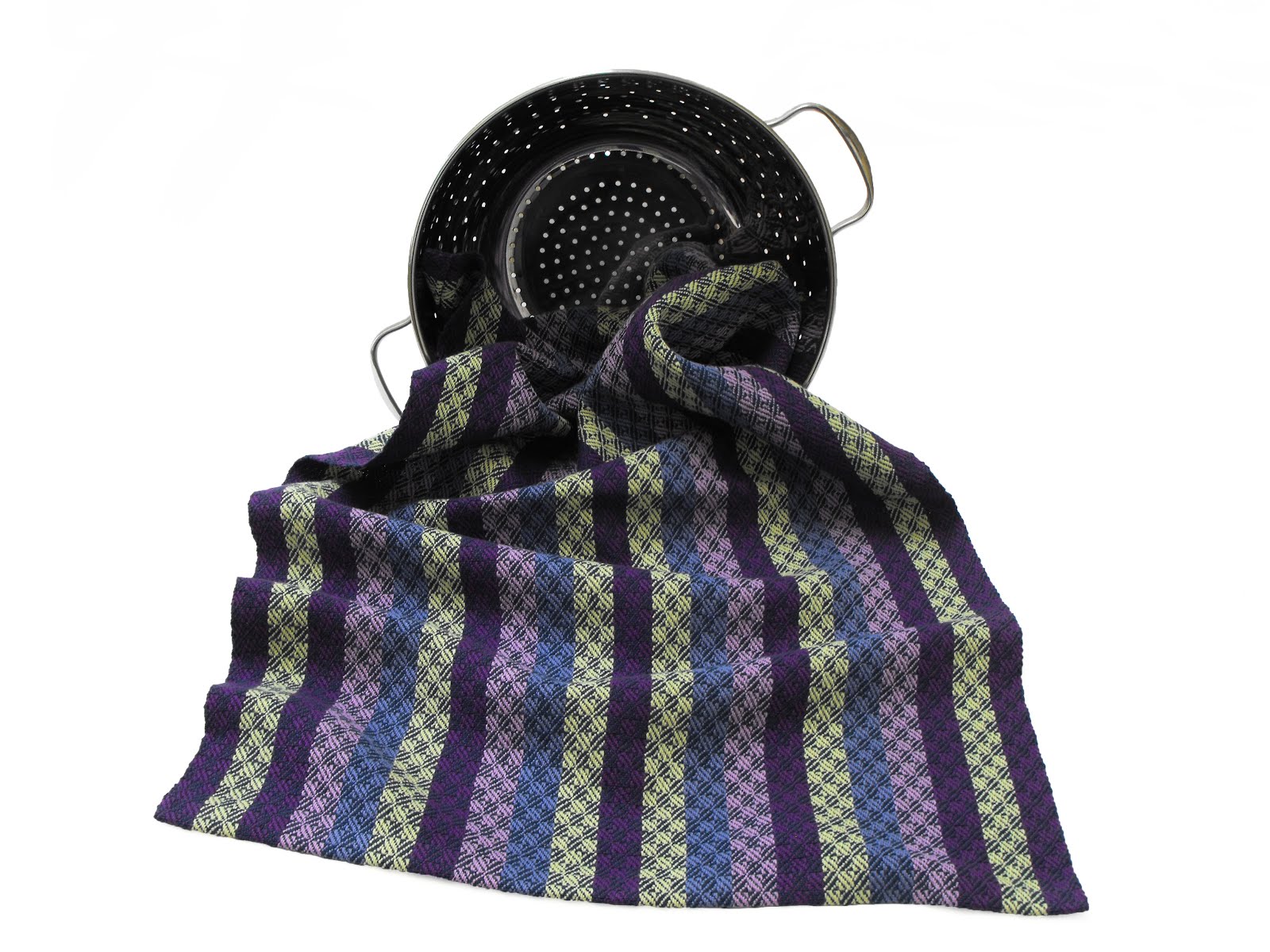
In the beginning of the year we are always drawn to tea towels.  This year I wanted to do lively coloured and thick stripes.  I was really drawn to the purples and a lovely lime green to highlight the colours.
I found a charming pattern on Handweaving.net that forms little boxes.  The pattern is a 3/1 turned twill also known as a drall.
The stripes are an inch wide and there are three boxes per stripe which makes them look even wider.  The weft for the tea towels is a lovely shade of blue from Brassards called Denim.
I put on 7 yards of warp for 6 tea towels 36 inches long.  At the end of the warp I had 26 inches left, so minus 12 inches for loom waste, I had 14 inches left over.
I came up with a great idea, bookmarks!  I tried out a couple of colours of 2/8 cotton but they were matte and boring.
So I tried some 2/8 Tencel in black and two navies, they had shine and were exciting.  So I had found my weft for the bookmarks.
I decided to only use some of the stripes.  And here is where I made the mistake; I decided to cut out the warp stripes that I wasn’t going to use.  I don’t know what I was thinking.  The tension on the warp went wild and I had to finish cutting the entire warp off.  Here is the chained off warp looking sad, maybe I will do some temari balls with it.
Here are the finished tea towels.  They look fresh and cheerful.  They remind me of the first spring flowers, crocuses.  For Sale.
One thing about the tea towels is that the lime green stripe doesn’t look green anymore.  The purple stripes and navy weft has pulled the green colour from the stripe and now it looks yellow.  I still think that they look great, but not quite what I had intended.
Final Garden Shot is Bleeding Heart.  I wish I had a crocus picture but a bunny dug the bulbs up and ate them!

Friday, March 2, 2018

Rosy Red Paper Spots Lace Runners

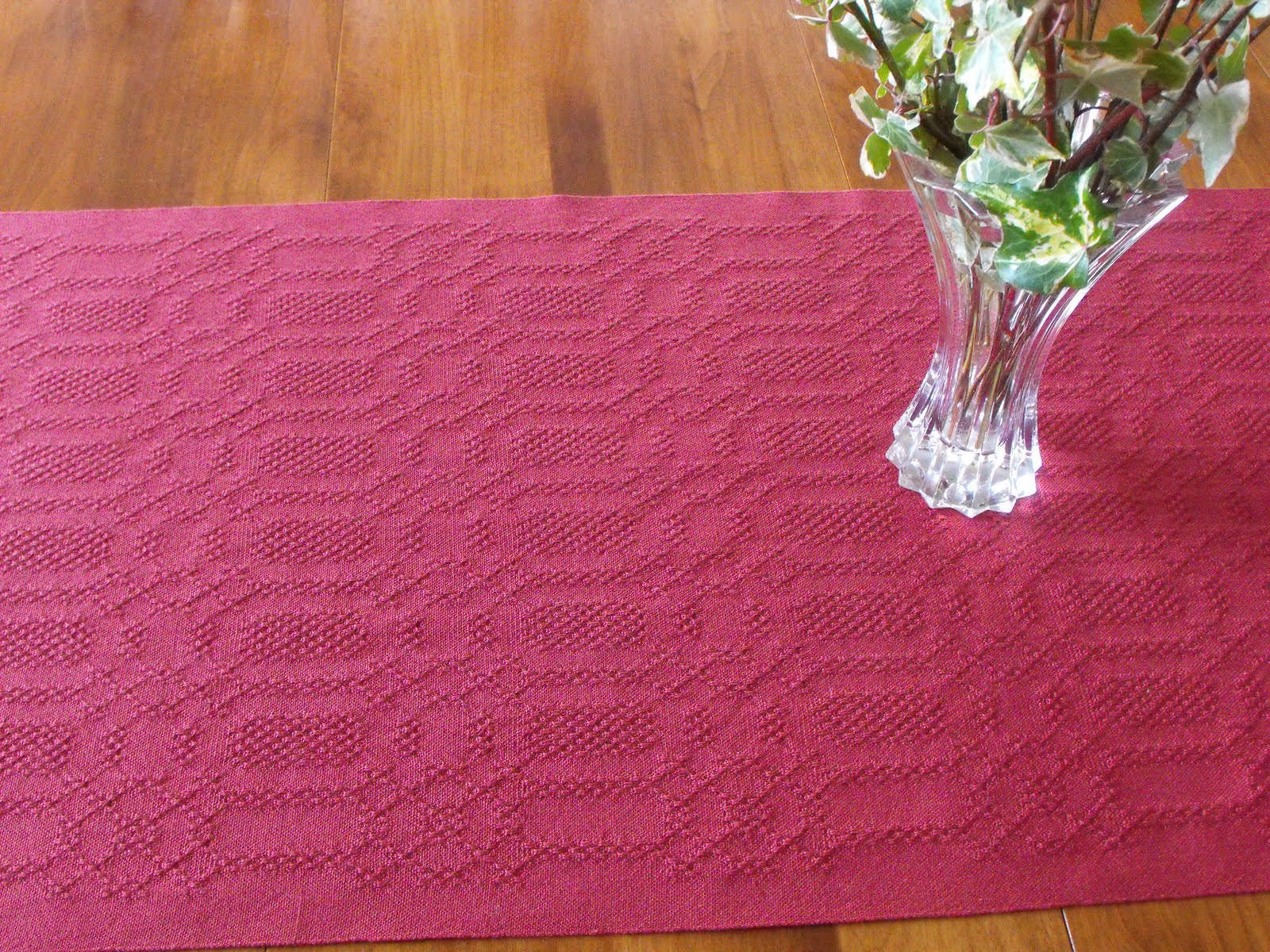
Back in December when Mum was doing her three golden huck lace diamond runners and I did some lovely rosy red lace runners.  I used a stunning cone of 2/10 cotton in a colour called Zinnia, which we bought from Susan at Thrums.  It's always nice to drive 'up island' to see her.
Looking through our lace drafts I found a lovely pattern in paper spots or dropped tabby lace, which Mum had published in Handwoven Magazine.  I like to take of picture of the border so I can remember how to end the runner.  There is nothing worse than getting to the end of the runner and trying to remember what you wove for the border.
After taking the photo I noticed a small lump on the front with further check found a large snarl on the back.  So I got to unweave a couple of inches.
The pattern is wonderful large circles of lace highlighted by a trellis.  It was a simple treadling and a joy to weave so the runner wove up quite quickly.
I am always delighted when I finish weaving the runner (or scarf or whatever) and the pirn finishes at the same time!
I changed the pattern a little for the second runner instead of circles there are long ovals of lace highlighted by a trellis.
After washing the runners the lace does what it does and puckers the runner, this is the scary stage when you wonder if it will ever iron flat.
I usually use a steam press to flatten the final piece but with lace you need to push the puckers out with an iron.  It is amazing how the lace changes.
I then used the steam press for the final pressing of the table runners.  Here is the finished runner with the circles.  For Sale.
Here is the finished runner with the long ovals.  The runners are quite stunning and the warm brick red is a lovely colour.  For Sale.
Final Garden Shot is of some bulbs just popping up from the garden, I am not sure what they are I have to wait for them to bloom.  The trellis is to stop the deer from eating the tender tips.

Saturday, February 17, 2018

Twelve Shaft Tea Towels

This time of the year I always seem to want to weave something simple and satisfying.  Tea towels always fit the bill.  My Louet Spring has twelve shafts but finding patterns using twelve is always a hunt.

This pattern was exactly what I was looking for, a lovely twill on twelve, and the threading and treadling couldn't be simpler.  Treadling a straight twill allows me time to make sure my posture and technique are correct.
I pulled an eleven yard warp in navy blue cotton and sett it at 24 ends per inch.  I beat these towels fairly hard to get a balanced weave. 
My plan was to weave ten tea towels in deep jewel hues; so I wove the towels in emerald, turquoise, ruby, garnet, sapphire and amethyst. 
Since I was weaving these in a single colour I did a short hem detail.
A tangle of towels waiting to have the selvedges finished.
A new addition for me is an upgrade from a Janome mechanical sewing machine circa 2003 to a Singer Quantum 2017.....holy cow have things ever changed during that time!  This baby even threads the needle by itself.  I think my only job is to choose the project.  Although some things will never change; that is my mothers sewing box in the background.
It was very satisfying to see the pile of sixteen tea towels ready to be washed and hand hemmed.   Ten are mine and six are Ngaires'.  We often share tasks, I cut them apart and finish the selvedges, Ngaire presses them and pins up the hems and then I hem them.  I’m still happiest with hand finishing because I don’t like the squished line that the machine gives to the hem.  It was a really good day for me, not only playing with my new sewing machine, but a couple of loaves of bread too.  The sweet smell of a successful day.

Tuesday, January 30, 2018

Cones

One of the great weaving questions is ‘How much yarn is left on that cone?’

I can’t answer that but what I can answer is, how much does that cone weight empty?  I started to keep a spreadsheet on how much the empty cones weight and the dimensions of the cone and I thought I'd share my data with you. 

I have found that Brassards from Plessisville, Quebec Canada uses the same tube for most of their 8 oz products – Average Weight is 0.40 oz.

2/8 Cotton Unmercerized

4/8 Cotton

2/16 Orlec

2/8 Orlec

1/16 Linen

2/9 Linen

2/8 Tencel

2/16 Bamboo

2/8 Bamboo


Webs in Easthampton MA, USA is another supplier that we use.  The 1 lb cones that they use are different sizes and shapes but I use this weight for a rough idea.

2/8 Tencel on 8 oz tubes is 0.25 oz

2/8 Tencel on 1 lb cones is 1.18 oz

2/20 Tencel on 1 lb cones


Sometimes weavers pick up cones and tubes from Guild Sales and you don’t know where they are from but maybe knowing the dimensions of the tube you can use these mystery cones as a reference.

Silk 2/6 weight is 0.90 oz

Mystery Blue Plastic Cone that contained 2 ply linen is 3.00 oz


I hope that this information helps you I know it helps me.

Wednesday, January 24, 2018

Hemming the Huck Runners

I took my three gold Huck Lace Runners off the loom just after Christmas, and then they languished.  I just couldn’t find the time to get to them.
The runners were made from 3/10 mercerized cotton sett at 24 ends per inch.  I put on a 4 yard warp and wove three runners:
#1 77-1/2 inches on loom
#2 55-1/2 inches on loom
#3 45 inches on loom

Finally, I cut them apart, machine finished the ends with a few lines of zigzag stitching and waited for a clear day to wash them.  And waited, and waited, it felt like we had rain every day for weeks.  I need a clear day so that I can use racks to flat dry the runners and having them dry outside is preferable.  Living on an island on the ‘Raincoast’ means high humidity and I could not bear to add more damp to the house!

I finally gave in and set the racks up in the garage and laid out the runners, three gold ones for me and 2  rosy brick for Ngaire ~ a true plethora of runners.
Ngaire and I often share the work load on runners and tea towels, so she got out ‘McSteamy’ our steam press and gave them all a first run through.  This photo was taken in our old house and darned if I don't still miss the sunny, dry Okanagan Valley. After the quick press Ngaire pinned up the hems on all five runners.
We had a lovely sunny day a couple of days ago, so sitting by the fire in the bright sunshine, which shows the runner colour up beautifully, I hand hemmed the lot.  What a feeling of success.  As I was hemming I thought about this blog post and decided I would share the a few thoughts on hemming table linens.
If you are weaving a runner with a pattern you should leave some ‘plain’ weave for the hem.  In this case since the runners were Huck, I was able to use tabby weave for the hems, but if I was weaving a fancy twill runner I would weave the runner in 1-2-3-4 straight twill.

I think that hems should be generous looking and be in balance with the length of the runner, in this case I wove 5 inches of plain weave, 1-1/2 inches for the fold under, 1-1/2 inches for the reverse side of the runner and 1-1/2 inches for the border on the front of the runner before the pattern begins.  The final 1/2 inch is for shrinkage and cutting off the machine zig-zagging I did to hold the fabric while I washed it.
After I have chosen a sewing thread in a matching colour for the runner I pass it through a product called Thread Heaven that my friend Susan at Thrums gave me.  This is a thread conditioner and it prevents the thread from fraying, tangling and twisting upon itself when you are sewing.  A really great product that makes the whole job easier.

I never, never, never use spit to wet the sewing thread when I thread the needle.  If you are selling the finished product, your customer deserves to have it arrive without your DNA!  Use sharp scissors to give you a clean cut and big-eyed needles to help you find the eye if necessary.
I prefer not to use a knot in the sewing thread to anchor and begin the hemming.  Rather than a knot I start in an inconspicuous place on the hemline and do a few running anchor stitches and then carry on from that point; I finish in the same manner leaving an inch or so of thread tail within the hem.  Knots can squirm through the fabric over time and pop through.

I always sew the side portion of the seam closed, this ensures that any raw edges are well protected inside the hem and I use ‘invisible’ running stitches to sew the hem.

After all the hemming is done it only needs a good heavy steam press is the final finishing touch, this runner still needs the Huck Lace areas tamed, still quite a bit bubbling in the plain weave diamonds!
The final length of the runners are #1 - 66 inches, #2 - 56 inches and #3 - 36 1/2 inches.

The garden shot today is of Campanula carpatica 'Clips Deep Blue'  commonly called a Bellflower, just beginning to show leaves, hidden under last years flower stalks.