Showing posts with label Diversified Plain Weave. Show all posts

Monday, July 18, 2022

Fleur de lis

Sorry for disappearing for the last two months.  I got diagnosed with Bell’s Palsy in May, which means that half my face is paralyzed and drooping.  One of the problems is that my left eye doesn’t close all the way so I haven’t wanted to weave in case fibres/dust get into my eye.  But now my face is starting to get better and I’ve started weaving again.

Last month I had someone interested in one of our original drafts, the fleur de lis diversified plain weave pattern.  The pattern needs some tweaking so I decided to weave the pattern again to get it perfect.

I started from the pattern which Mom created to make table runners.  I pulled everything out of the stash that could be used for a table runner.  Diversified plain weave is a very hungry weave, it needs two types of threads, one thick and one thin in the same (or similar) colour for both the warp and the weft.  So it can be challenging to find yarn that works. 


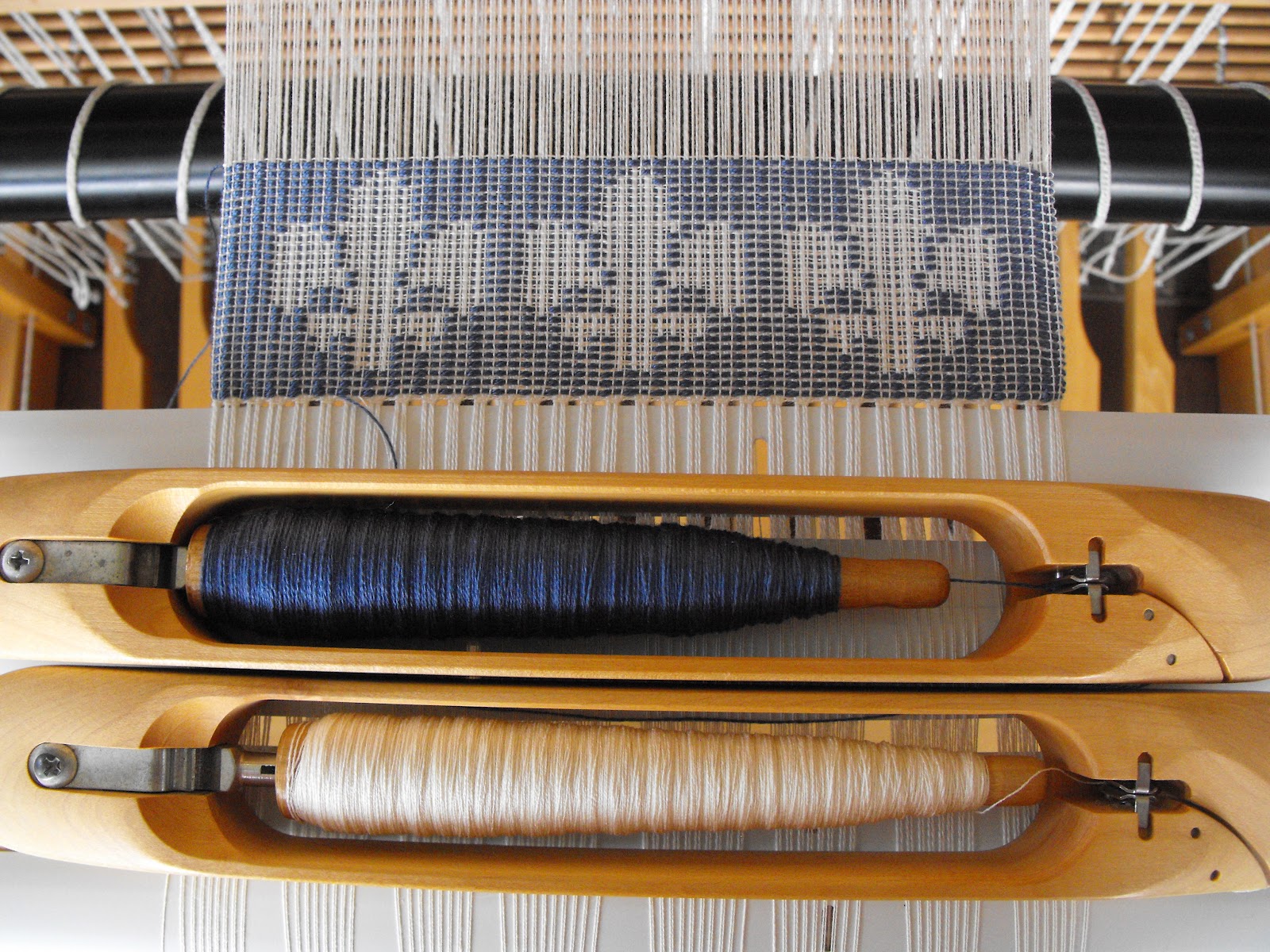
I’m also trying to make a project guide to sell as a PDF on Etsy, so I also need to use yarns that you can currently buy.  I ended up ditching the table runner idea and going with a Tencel scarf.  The warp is 2/8 Tencel in white and white sewing thread.  It was very slow going to pull the warp with such a fine thread as sewing thread!

One of my favourite steps is trying the different weft options, in this case grey teal, Ming blue, blueberry and azure, all different blues.

The fleur de lis pattern is looking pretty good but I can see a few more tweaks are needed to make it perfect. The pattern can appear quite different when woven compared to how it looks on the computer.  

The colours and motif looked quite familiar then it dawned on me that my scarf is going to be similar to the flag for Quebec!

The garden is still struggling with the colder weather, it is definitely Feb-uly.  But plants are starting to bloom and the summer colours are starting to come into their summery best.

The tomatoes in the greenhouse are almost to the ceiling and laden with fruit, but nothing ripe yet, but the cucumbers in the back corner are the star right now and giving us a cucumber almost every day!

Monday, September 28, 2020

The End of Diversified Plain Weave

 I’ve started my third and final Fleur de Lis  runner and I must admit that I’m more than happy to see the end of this project.  I find that I can only weave for a very short time and then the fatigue of lifting 13 shafts on a treadle gets to me.   I can’t see myself choosing to weave such an unbalanced weave again, but I guess, never say never!

For this runner I am using a lot of what I learned in the previous two runners.  I am using the improved motif and the thinly woven hemline.  

My yarns are 2/8 orlec in dark teal and 2/16 cotton in blue teal.  When I went to take the photo and sat them on the shelf beside the fireplace I instantly know where the colour inspiration came from.

The plan for this runner is to weave 2 inches of hem in fine cotton only, to ensure it sits within the hem neatly.  Then to weave  2 inches for the underside covering hem and 4 inches of plan pattern before beginning the motif; hopefully this will allow the motif to begin away from where the runners drape over the table.  I am spacing my motif a full 2 inches apart on this runner.

I’m pretty happy with it so far and the colour is better than I had hoped, now only 50 more inches!

Yesterday I embraced autumn with my first seasonal pie.  I can’t call it Pumpkin Pie because I don’t actually use pumpkin and Butternut Pie doesn’t have the same ring to it; but, that’s exactly what it is....baked butternut squash makes a wonderful pie and I think has a much better texture and less bitterness than pumpkin.  My spider web was a bit messy, but oh so tasty!

The garden shot for today is  Leycesteria formosa commonly called Himilayan Honeysuckle or Fowering Nutmeg.  This is an amazing plant that is in flower for most of the summer and keeps the pollinaters very, very happy.  Then in the fall it produces these beautiful berries in hanging clusters.  Surprisingly the fruit is edible and tastes a bit like chocolate and kind of like molasses.

Monday, September 14, 2020

Diversified Plain Weave Continues

I’m still plugging along on the Diversified Fleur de Lis.  It is a very slow weave and I must admit that I am finding a multitude of reasons not to weave.

I am about half way through weaving runner number two and I have tried a couple of new things with this runner as well as the improved fleur de lis motif.

I was a tad worried that due to the thickness of the weave that the hem may not lay as flat as I would wish.  So I used 2/16 orlec in white ~ the same as the thin yarn in the warp ~ to weave the 2 inch hem in pattern that will be folded into the actual hemline.  It is substantially thinner and I think it will work well and be hidden within the fold.

I originally planned to use a lovely pure blue 2/8 bamboo weft for runner number two.  This should make the fleur de lis motif brighter by swapping out the thin blue 2/16 yarn for the same thin white yarn I used in the warp.  Well, it only took a handful of picks before I saw that it didn’t work, I got a spotty ‘dits and dots’ look.  I also had huge issues with the bamboo weft.  This bamboo yarn was first generation bamboo and it was almost round rather than oval and very tightly twisted, this made the selvedges horrible, so out it came.

Here is where I really appreciated my ‘improved’ stretchers.  I have pretty much given up on the use of temples, they often feel too heavy for the woven web and frankly are a bit cumbersome to move.

I moved to this type of home made paper clip stretcher and it has worked well, although it does have a propensity to pull little distortions in the web.
I have swapped the paper clip for these small bulldogs and it was a real ‘hallelujah’ moment.  Because I have increased the size on the contact with the web I have been able to add more weight to the stretcher, so it is a lovely improvement.

I had a good think about weft yarn, and since my intention was to weave a longer runner for myself I chose these two, lets face it pink can be quite divisive, it’s not to everyone's taste. The thick yarn is rose 2/8 orlec and the thin yarn is 2/16 dark rose mercerized cotton.  These two combine beautifully, but photograph poorly.

The actual fleur de lis is much more subtle on this runner and has proven quite difficult to capture on camera.  In person it is still very subtle, but much clearer.

Part of the problem with photography during the past four days has been the smoke from the west coast fires in the USA.  


We have been completely blanketed and under inhalation warnings, so staying inside whenever possible.  We are still the lucky ones in this horrendous event and our hearts go out to those who are closer and more directly effected by the devastation the fires have caused.

Ngaire took this photo last week while we were basking in our summer 2.0.  This is a pretty wonderful shot of  Cotinus Coggygria ‘Golden Sprite’ or Golden Smoke Tree from above.  Mother Nature sure knows how to make thing beautiful!

Wednesday, August 26, 2020

Fleur de Lis Diversified Plain Weave Again

 There is so much going on around here that I completely forgot to write about the progress on my Fleur de Lis in Diversified Plain Weave this week.

It certainly has been a voyage of discovery for me beginning with the ‘aha’ moment when I discovered that my treadling was upside down!

I guess that my usual style of pattern motif is symmetrical and this Fleur de Lis is definitely not that.  I printed the treadling off of Fibreworks and got down to weaving and although I thought the motif was weird, I was so focused on the selvedges that it didn’t click right away that it was upside down.

Once the entire motif was woven, it was apparent that I had forgotten that the pattern is pictured on Fiberworks from behind the loom, not from in front of the loom.

I know that it really doesn’t matter in which direction the pattern appears since it will the same from top to bottom on the runner.  I just didn’t like weaving it upside down, it messed with my thought pattern (I really am a linear kind of gal!)  So, I unwove the pattern and re-wove it from the bottom of the pattern to the top and I’m much happier.

Usually I am meticulous about when and how I add new threads to the web, habitually I add at the selvedges.  For some reason,  I decided to add the new fine thread whilst in the midst of the runner.....why, why, a thousand times why?   You can barely notice it on this side of the cloth (about 10 threads to the left of the flower), but I got a glimpse of the other side while advancing the warp and yup, there is was, front and centre!  

As I near the end of the runner, yet another problem has appeared.  My hanging selvedge threads which were made out of the ‘not cotton’ thick warp threads have started to fuzz and fray and snap. 

I have had to re-hang the selvedges twice on the right hand side so, I will be pulling off these ‘not cotton’ selvedges and replacing them with 2/8 cotton for the next runner.

Speaking of the next runner, while I was weaving this runner I noticed that treadle #5 and treadle #14 were the same. I haven't a clue why I didn’t see it before.  Regardless, I went back to the computer and with some fiddling around I was able to amend my Fleur de Lis and make just a wee improvement now that I had another treadle to play with.

I think that the little drop near the bottom of the motif takes it out of ‘possible space ship’ motif and firmly anchors it in Fleur de Lis!

The garden shot today is of the greenhouses’ progress with our Vanilla Strawberry hydrangea (Hydrangea paniculata’Renhy’) in the foreground.


Monday, August 10, 2020

Diversified Plain Weave Fleur de Lis

 I’ve decided that it’s time to tackle a project that is quite challenging and that has been on my bucket list for awhile.

A couple of years ago my guild study group project was to explore Diversified Plain Weave.  The end result of my study was that I developed a pattern for a Fleur de Lis.  Ngaire posted a really good explaination of the ins and outs of diversified plain weave here.

I wanted to weave this pattern as a table runner so I began hunting through my yarn ‘stash’ for an appropriate warp yarn.  I found a 2/8 mercerized cotton and a 2/16 orlec in white that will do nicely.  The warp for diversified plain weave is two thin ends followed by 2 thick ends; the best ratio is that the thin ends should be 1/2 the grist of the thick ends.

I pulled the warp of 746 ends in three bouts, alternating 2 thin and 2 thick ends.  I had 372 ends in 2/8 cotton and 374 2/16 orlec ends by the end of it.  

I was well into pulling the warp and I thought that my 2/8 cotton (it was labled that way) just felt ‘un-cottony’.  So I did a burn test and, it was definately not cotton, the melted blob at the end proves it isn’t cotton at all!  I was much too far along to do anything but to proceed.

Diversified Plain Weave is in no way a balanced weave because of the tie down threads.  My pattern called for 186 ends on shafts 1 and 2 and a whopping 236 on shaft three, the rest have only 16 ends on them.  My loom is set up to have 100 ends on every shaft, so moving heddles was on the agenda.

To move heddles on the Louet Spring Loom is daunting to say the least.  My first job was the count out the heddles to move from the back shafts.  I took 80 each from the back 4 shafts.  To make sure the texsolve heddles don’t twist during transport I put a blue twist tie through the top and bottom of the back of each heddle bundle and a black twist tie through the front. 

Now comes ‘biting penguin’ time.  These little holder/adjuster thingamabobbies are lethal!  To get the heddles off the shaft you have to pull the texsolve shaft lines out of the adjusters, hold the two ends of the shaft open and move over the heddles, then re-affix the shafts.  Let me tell you, there are always tears and broken finger nails!  Now to do the whole process again to add the heddles to the front three shafts.

My plan told me that I was going to beam the runner at 24 ends per inch, so I put the warp threads though the raddle on top of my loom as 6-6-0-6-6 ends to spread it evenly.  I was almost half way done and had far too many ends left.

So I went to the computer and had another look at my plan and saw that I had counted the 2 thick ends as one, since they are duplicates.   In fact I don’t have 24 epi I have 34 epi, so I had to move every thread over.....can you see a pattern here.....gotta check things out before I jump ahead!

The threading was pretty simple because most of the ends are on the first 3 shafts.  I have decided to lash on the warp this time.  Generally I tie on my warps (see here for how I do it), but yet again I hadn’t think things through!  I hadn’t actually thought about how long the runner(s) would be before I pulled the warp.   I wanted to get three runners – small, medium and large out of this warp and so saving as much warp as possible was key.

After the warp was loosely lashed on, I tightened the tension and kept my eye on how tight the lashed on bouts were.  As I started to feel them tighten I checked the overall tension by running my hand on the warp web behind the beater bar.  This gives you the most accurate feel.

Now that a few of the bouts were pretty tight, it was time to play the lashing like a harp.  You find the loosest bouts and pluck the slack up and distribute it to the tighter bouts.  The end result is a very even tension.

To splay the warp web evenly I put in a couple of venetian blinds and then a couple of thick soft yarns and now I’m ready to start.

At this point I know I want three runners.  My table is 71 inches long with a 2 inch drop over the edge; so I knew that my longest runner had to be about 80 inches to allow for hem and take up.  The shortest should be about 50 inches including hems and the middle length is somewhere around 66.  Since I have never woven this pattern I have no idea what height each of Fleur de lis motifs will turn out, so I will start with the smallest runner and figure out how much between each motif by trail and error.

 My garden photo today is of my lovely little garden shed.  My husband built it out of HardiPlank several years ago and here it is on it’s final day before we start tearing it down.  We have ordered a greenhouse and this just had to go!

Monday, October 28, 2019

Finishing up the Chenille Scarves

This is the second installment for this diversified plain weave scarf, the first part of the story of the music note scarf;  is here.  Once I finally got the motif and the threading (had to redo it three times!) correct for this scarf it quickly wove up. 
It wove up so quickly that I only took one set of pictures, it is a little hard to see but I wove the second motif upside down so that when the scarf is finished the ends will match when worn.
The music note scarf joined the black piano scarf in the closet waiting for a sunny day to do the sewing for the hems.  Definitely need a lot of light when trying to sew a black scarf.
But they are now both done and here are the beauty shots.  The black piano is quite striking.  For Sale.

I preferred the black music notes with the white background for the music note scarf, so it turns out that I actually wove it upside down.  But it is pretty and continues that music theme that I have for the chenille scarves.  For Sale.

In the end I was able to weave three white piano scarves, one black piano scarf and one music note scarf.  It is quite a stack of finish scarves.
I am finished with weaving chenille scarves for the year but I was able to tidy up my pile of black and white chenille.  I emptied two cones and two tubes, the leftover tubes now fit in one of the tubs that we use to corral the weaving yarns in the closet.  I think it was a success!
Final garden shot is Feather Reed Grass (Calamagrostis acutiflora 'Eldorado') when the light hits it, it seems to glow a wonderful golden colour.