Tuesday, April 12, 2016

Diversified Plain Weave

After the Piano Scarves were finished I had fifty three inches of warp left on the loom.  It wasn’t enough to do anything with but I had an idea.
I pulled two chenille threads off the old warp and knotted them together and placed them on the warping board; I did this for all the other warp threads, ending up with half as many warp threads.  The other threads on the warping board are thin 2/20 Tencel in white.
To put some tension on the warp I put a small binder clips on the bottom of the threads to stop them from sagging on the warping board.  It worked surprisingly well.
At this point the warp is now half sized.  But I had a little bit of white chenille on the bobbin and some on the cone left.  So I pulled the rest of the warp normally.
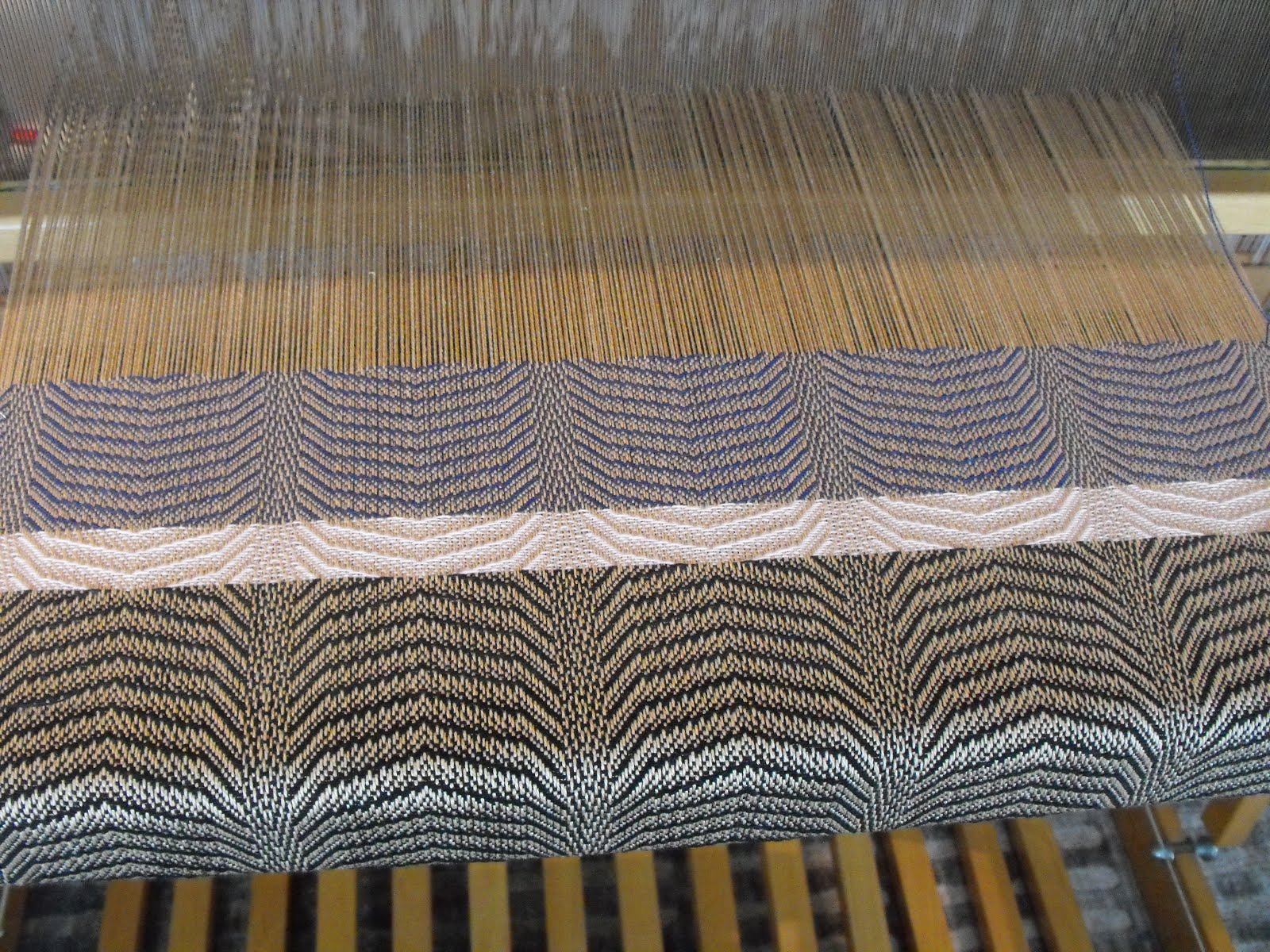
It is my first time doing Diversified Plain Weave there is one thick thread to every two thin threads.  The thin threads are woven in plain weave and they are the back bone of the weave structure.  The thick thread is the pattern thread and is tied down by the thin threads.
I set up the treadles a little differently this time.  I place the two plain weave treadles right in the middle and the pattern treadles on the outsides.  Sorry for the tilted picture!
I created my own Diversified Plain Weave pattern, it used all twelve shafts.  It is a pretty diamond motif.  But for some reason my loom didn’t like weaving the pattern.  The treadles were very heavy but I had the treadles evenly balanced six shafts going up and six shafts going down.  Also my loom made some loud wooden snapping sounds.  It was like some of the shafts were crossing and sticking together.  I have no idea what was wrong.
But I like my loom more then I liked the pattern!  So I stopped weaving the pattern.  I unwoven what was there and I started all over again.  I went to back to the Handwoven article (May/June 2013) that I was using as a reference and used the draft.  It is large circles on eight shafts.
Diversified Plain Weave is a two shuttle weave.  Again one thick thread and two thin threads are used.  It was quite easy to get into the rhythm of using two shuttles.
The finished Diversified Plain Weave scarf has joined its friends the Piano scarves waiting to be hemmed and washed!
The Final Shot.  The Snowbirds Air Demonstration Team are back for the Spring Training session at the Comox Air Force Base.  They are here for two weeks and they practice twice a day.  You can go to the appropriately named Air Force Beach and watch the air show and listen to the commentary.  Next week the CF -18 Hornet demo team arrives and it is very loud!

Sunday, April 3, 2016

Piano Scarves – Again

When Mum and I cleaned out the stash in January, we found some black and white chenille, which I only use for one thing – Piano Scarves!  There was only a little bit of white left; just enough for two scarves.
The warp is white chenille with a band of black on one side.  The draft is just a four shaft plain weave.  All the patterning comes from the clasped weft technique.
I use a large 15 inch boat shuttle made by Little Man Howell to hold the chenille.  It holds enough chenille on it for more than half of a scarf, about forty inches.  It is just amazing.
The scarves wove up quite fast this time.  But I caught the ‘flu and I have been sick for a couple of weeks.  So the scarves have been sitting in a pile waiting for me to hem them.  I’ll get to them soon, promise!
Whenever I do these scarves I always run out of warp.  I have had to add extenders onto the warp a couple of times.  So this time I added extra warp - just 18 inches - but enough I hoped.  Well somehow I ended up with 53 inches of warp left over!
Not enough to do anything with – or is it ?!  Find out in the next blog post.

Final Garden Shot is the first leaves and catkins on the weeping variegated willow.  So pretty!

Sunday, March 20, 2016

The Finished Pima Cotton Runners - 8 Shaft Twill

To recap the 8 shaft twill table runner project that I did a month or so ago; the warp was 2/10 Pima Cotton in a lovely warm shade of wheat.  I wove three table runners in three different lengths and in three different colours.  
I started with the shortest runner first, in green 2/8 Orlec.  I was hoping for a 30 inch runner and the finished dimensions are 32 inches long and 19 inches wide, pretty good!   The runner has a very lovely chain of diamonds pattern.  The colour combination reminds me of the late summer; when the wheat starts to ripen in the fields.  For Sale.
The second runner was woven with 5/2 black cotton in a slightly different pattern, this time with two different sizes of diamonds in a chain.  The finished dimensions are 49 inches long and 18 ¾ inches wide.  I was hoping for 50 inches but I finished the cone of 5/2 black and had to weave the last inch of the hem in mercerized 2/8 cotton!  For Sale.
The last runner was woven with 2/16 ink blue cotton.  This pattern is my favourite with the large X’s.  The final runner was going to be 70 inches but there was some extra warp at the end so I was able to weave the runner a little longer.  The final dimensions are 79 inches long and 18 ¼ inches wide.
When Mum saw the ink blue runner on the table she wanted to keep it.  So it is hers now!  And it looks great on the dining room table.

Final Garden picture is a Prairie Crocus (Pulsatilla vulgaris) just starting to bloom.

Monday, March 14, 2016

Theo Moorman on Three Shafts ~ A Scarf

I am involved in a study group with my guild, the Qualicum Weavers and Spinners; and this year our topic is inlay.

I thought I’d take a look at the Theo Moorman technique of inlay and see how far I can go with it. Typically, this technique is used in tapestry or ecclesiastical weaving, and it involves a surface design element laid over a woven background cloth.  The inlay is held in place by a nearly invisible tie down thread which is hidden within the warp and only surfaces when needed.

I thought I’d start with the simplest permutation of Theo Moorman; that is plain weave ground cloth and one tie down thread; so, only three shafts are needed.

I found this pattern in Handwoven Magazine May/June 2013; the pattern was created by Line Dufour (you can read her blog here).

I pulled the ground cloth warp ends separately from the tie down ends and this created a bit of a problem for me. How was I going to get them to interleave; since I prefer to warp back to front.  I ended up using two sets of lease sticks, one for each warp and after the ends were spread I lashed them together.
This worked perfectly! The ground cloth is woven on shafts 1 and 2 alternately and the surface design is laid in on shaft 3.   The tie down threads are always in play and move with shaft 1 while creating the background and independently on shaft 3.
This scarf wove up very quickly and frankly I  found it a bit boring.
 I am a bit concerned that the underside of the scarf has quite a bit of pattern telegraphing ~ not enough to be interesting but enough to notice.
I was really concerned when I pulled this scarf off the loom; it was as stiff as a board and during the weaving process the Tencel had completely lost its lustre!

I had my fingers crossed as it went into the Eucalan wash, hoping it would soften.  After it dried it was much softer but still not very supple.  I guess that it is the nature of plain weave to be firm, but this was unpleasantly firm!
I decided to throw it into the dryer with a clean towel on the Air/Fluff setting and viola ~ it came out wonderfully supple!
I will periodically be working on Theo Moorman’s technique throughout the year and I hope to see just how far I can push the concept and still make a wearable scarf or shawl.

Monday, March 7, 2016

8 Shaft Twill Runners Part Two

I finished the last blog with the first runner being woven in green Orlec and woven to a length of around thirty inches.  The next runner up is 2/5 black perle cotton weft and woven to a length of fifty inches.
The pattern for this runner is two different sized diamonds running the length of the runner.  It is a very large and graphic pattern.
I weighed the black cone and did the math; I knew it was going to be close.  I had half a pirn left to weave the 6 inches of hem.  I actually had to weave the last inch in black mercerized 2/8 cotton.  It is going to be the turned in part of the hem so it will not show.
If you look closely in the picture you can see the slight colour change of the two different black wefts.
The next runner is the longest at seventy inches and is woven in 2/16 royal blue mercerized cotton.  This pattern of the boxed X’s is my favorite of all three, which is why I chose to weave it for the longest runner.  
I have woven the seventy inches for the runner.  Then I look at the back of the loom and I have about thirty inches left!  It is very rare that I have extra warp.
So I was able to weave two extra pattern repeats and six inches for the hem.
Ahhh, yup that looks like one of my warps, the metal rod is on the back heddles and there is no shed left in the front!
I was interested to know what the loom waste was for this project.  When I cut off there was twelve inches of warp left.
The dust bunnies from the Pima cotton were amazing!  I placed a shuttle beside them for scale.
The fluffy dust covered the shafts and the lamms.  So a good vacuuming is needed before the next project!
The runners will be finished for the next post.  Here is the Final Garden Shot, it is a Hydrangea already showing a flower bud.  The green mass behind it is a Stella De Oro Daylily.

Tuesday, March 1, 2016

Pima Cotton Runners in 8 Shaft Twill

This is the  Pima cotton that we previously split from a large cone of  six ply cord.  We were able to break it down into these six balls and they are approximately 2/10.
I pulled a warp that was six yards long for this project.  I wanted to do three different sizes of table runners; one at thirty inches, one at fifty inches and one at seventy inches.  Now that it is on the loom you can still see the kink from the being un-plyed.
The weft colours I have chosen are a 5/2 black perle cotton, which according to my math will be just enough to do the fifty inch runner.  The second cone is 2/16 royal blue cotton there is lots so it will be the seventy inch runner.  There three cones of Orlec in different shades of green and one will be my choice for the thirty inch runner.  Sorry for the blurry photo
 I was going to weave the longest runner first but Mum said do the smallest first because if I run out of warp at the end the smallest runner could be too small to work as a runner but if the longest runner was a couple of inches too short it wouldn’t really matter in the long run.
So on to weft sampling for the small green runner;  it is quite hard to photograph greens but the three shades are a dusty green, a fresh green with a little blue and a green with a little yellow.
The pima cotton is a lovely shade of wheat so I thought that the green/blue colour would work but nope (it is the one on top).  The clear winner is the green/yellow.  And this is why I sample every possible colour because I really never know what is going to work.
I had two mistakes to fix at the beginning of the weaving.  I had a threading error on one edge of the runner.  Instead of 4-1 I reversed it and went 1-4 so the twill was inclining the wrong way.  In about the middle of the warp I had what I thought was a threading error but it turned out to be a denting error, three in a dent instead of two.
I also had a pirn winding problem.  Sometimes the thread is put on the pirn a little loose near the end because the thread is starting to burn going through my fingers.  And when it pulls through the end feed shuttle it can tighten on the pirn and it makes a bit of a squirrels nest.  So, the only thing to do is pull it all out, untangle it and wind it back onto the pirn.
I have three different treadlings for this draft, which is one of the reasons that I picked it for the three runners.  Here is the treadling for the green runner which is the smallest; it is a chain of diamonds running the length of the runner.
That’s it for now . . .

Final Garden Shot is the first shoots of the Bleeding Hearts (Dicentra)